



3 Methods
To assess the impact of the embedded analytics plugin on the micro-agency workflow, we adopted a single-case pre-test/post-test design. We compared the traditional manual assessment process with the redesigned workflow after the deployment of the ClientRank plugin, focusing on process metrics and workflow maps rather than on statistical generalization.
3.1 Research design
The unit of analysis is the client assessment process that turns raw e-commerce data into an actionable baseline. In the pre-test condition, we reconstructed the manual process used by the agency before the plugin, including main steps, hand-offs and waiting points. In the post-test condition, we documented the workflow after the plugin was integrated, when data extraction, RFM computation, clustering and reporting are performed inside WooCommerce. For both conditions we measured TTA and DI and summarized the process in comparable workflow maps. As a single-case design, the evidence is illustrative rather than statistically generalizable.
The study was conducted within P&F Technology, a micro-agency that manages multiple WooCommerce clients. For the empirical illustration we focus on one WooCommerce store, using transactional data (orders and customer records) extracted from the native database. The observation window covers monthly sales from January 2022 to January 2025, and all customers with at least one completed order in this period are included in the analysis. TTA and DI were computed for projects completed before and after the introduction of the plugin in the agency’s assessment workflow.
ClientRank is installed as a standard WordPress/WooCommerce plugin on the client store. It connects to the WooCommerce transactional database using the platform’s native access mechanisms and reads orders, customer identifiers and monetary values directly from the store, without manual exports or file exchanges. Configuration parameters (for example, date range and inclusion rules) are set through the plugin interface and can be updated by agency staff. The deployment took place in the live agency environment and was monitored to verify correct installation, database connectivity and acceptable performance.
We use two practitioner-oriented metrics to operationalize the MAB. TTA is defined as the elapsed time between project start and delivery of the first assessment report to the client. DI captures the share of that time spent waiting for client data, that is, from the first request for data to the moment a complete, usable dataset is available for analysis. Timestamps are obtained from project logs, calendars and email exchanges. In addition, we document qualitative features of the workflow (number of steps, hand-offs and external dependencies) in pre and post process maps.
3.2 Analytical pipeline (RFM and K-means)
The analytical pipeline implemented in the plugin is summarized in Figure 1 and consists of five automated steps:
• Data extraction: transactional data are read directly from the WooCommerce database for the selected period.
• RFM calculation: for each customer, recency, frequency and monetary values are computed from the order history.
• Data scaling: R, F and M variables are standardized so that they contribute on a comparable scale to clustering.
• Cluster selection: K-means solutions are estimated for a small range of candidate cluster numbers; for each solution, Within-Cluster Sum of Squares and silhouette coefficients are computed, and the selected number of clusters balances parsimony and segmentation quality.
• Customer clustering and reporting: customers are assigned to clusters, and the plugin generates summary statistics and visual panels (trend and seasonality, device mix, geographic concentration and cluster profiles).
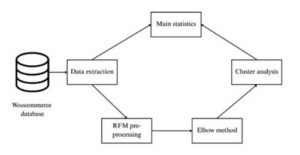
Figure 1: Analytical pipeline of the ClientRank embedded plugin for WooCommerce
Source: Author based on the ClientRank implementation at P&F Technology
Because the pipeline is fully embedded in WooCommerce and can be re-run by agency staff without additional coding, it provides a standardized segmentation routine that can be replicated across clients.
4 Results
The deployment of the embedded analytics plugin on WooCommerce (ClientRank) removed the micro-agency’s assessment bottleneck and produced two classes of outcomes: (i) descriptive and segmentation outputs that now form a standardized assessment deliverable, and (ii) process outcomes on TTA and DI.
4.1 Descriptive analytics: trend, device, and geography
ClientRank’s descriptive layer provides an immediate, standardized situational picture for new engagements. The focus is to surface a small set of patterns that are consistently useful in early-stage decisions. Figure 2 reports monthly sales over the full observation window. This view is used to frame discussions on trend and seasonality and to benchmark future interventions against past performance.
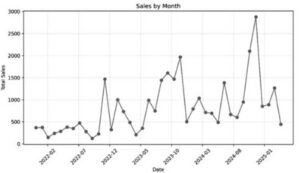
Figure 2: Monthly sales evolution: January 2022 – January 2025
Source: WooCommerce transactional data extracted via ClientRank plugin
Figure 3 shows cumulative sales by device type. Mobile accounts for roughly 68% of total sales, materially outweighing desktop. This confirms that optimization efforts on mobile can have a disproportionate impact on revenue.
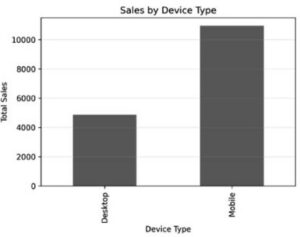
Figure 3: Cumulative sales by device type (mobile vs. desktop): Mobile accounts for approximately 68% of total sales
Source: WooCommerce transactional data extracted via ClientRank plugin
Figure 4 reports the top Italian provinces by cumulative sales. Revenues are highly concentrated: the Rome province (RM) contributes more than 45% of total sales, followed by Perugia (PE) and Chieti (CH).

Figure 4: Top 10 Italian provinces by cumulative sales (RM = Rome; PE = Perugia; CH = Chieti)
Source: WooCommerce transactional data extracted via ClientRank plugin
These three standard views (time, device, geography) can be refreshed in minutes from the store database and reused across clients, providing a consistent „first pass“ descriptive frame for the segmentation results that follow.
4.2 Automated segmentation: elbow-validated k and cluster profiles
The RFM and clustering pipeline implemented in ClientRank generates an embedded customer segmentation that can be directly reused in campaign and offer design. The elbow method applied to Within-Cluster Sum of Squares supports a three-cluster solution (k = 3), and the corresponding silhouette plot shows consistently positive coefficients across clusters, with individual cluster coefficients of 0.518 (Cluster 0), 0.520 (Cluster 1) and 0.524 (Cluster 2), and an average silhouette coefficient of approximately 0.52. This indicates a well-separated partition suitable for operational use. The 3D RFM scatter for the 2024 sample (outliers removed) is shown in Figure 5.
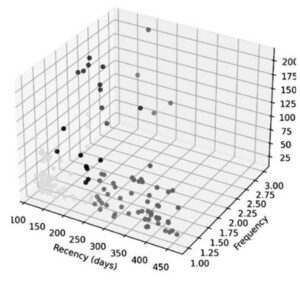
Figure 5: 3D scatter of RFM clusters (2024 sample; outliers removed), showing visual separation of the three K-means clusters
Source: ClientRank output on WooCommerce data
Cluster-level descriptive statistics (minimum, maximum, mean, standard deviation and variance for R, F and M, plus cluster sizes) are reported in Table 1.
| RFM | Cluster | Label | Min | Max | Mean | SD | Variance | Count |
|---|---|---|---|---|---|---|---|---|
| Frequency | 0 | High-value loyal | 1 | 3 | 1.7 | 0.66 | 0.43 | 20 |
| Monetary value | 66 | 208 | 137.85 | 44.54 | 1983.95 | |||
| Recency | 117 | 278 | 195.1 | 46.97 | 2206.52 | |||
| Frequency | 1 | Occasional/low-value | 1 | 2 | 1.04 | 0.19 | 0.03 | 57 |
| Monetary value | 20 | 165 | 58.81 | 32.54 | 1058.68 | |||
| Recency | 262 | 460 | 366.54 | 58.02 | 3365.9 | |||
| Frequency | 2 | Dormant with potential | 1 | 2 | 1.04 | 0.2 | 0.04 | 74 |
| Monetary value | 20 | 118 | 52.86 | 24.48 | 599.11 | |||
| Recency | 115 | 255 | 149.74 | 28.92 | 836.14 |
Table 1: Cluster-level RFM descriptive statistics (K-means solution with k = 3)
Source: ClientRank output on WooCommerce data
At a high level, the three clusters can be summarized as follows:
• Cluster 0 – High-value loyal (n = 20). Small group with the highest monetary value and relatively recent purchases, representing core customers whose spend should be defended and gradually expanded.
• Cluster 1 – Occasional/low-value (n = 57). Broad base of customers with low frequency and modest monetary value, suitable for low-cost, scalable engagement initiatives focused on encouraging a second purchase.
• Cluster 2 – Dormant with potential (n = 74). Customers who have not purchased recently but exhibit a monetary history that justifies targeted re-activation attempts.
The segmentation output is intentionally minimalistic: only variables that can be acted upon in small projects are surfaced. Detailed marketing and operational plays derived from these clusters are discussed in the Discussion section.
4.3 Process evidence: pre/post workflow and TTA/DI
The second class of results concerns the micro-agency’s assessment process. Figures 6 and 7 summarise the pre and post workflows, while Table 2 reports the corresponding TTA and DI ranges. Pre-plugin (Figure 6), the assessment path is long and fragile: data request, waiting for files, manual cleaning, import, exploratory analysis, manual segmentation, and reporting. Each node is a potential failure point and a source of delay, particularly the waiting time for client exports, which dominates TTA.
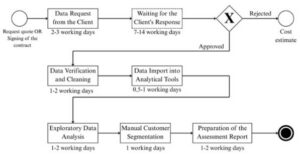
Figure 6: Pre-plugin business-process map for customer assessment
Source: Author based on P&F Technology process documentation
Post-plugin (Figure 7), the path is shorter and largely automated: one-time installation and configuration, automatic connection to the WooCommerce database, automatic extraction and descriptive statistics, automatic clustering, analyst interpretation, and reporting. The number of hand-offs is reduced and the critical path is no longer dependent on client responsiveness.
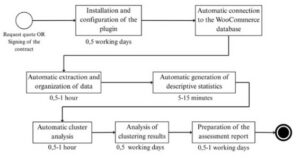
Figure 7: Post-plugin business-process map for customer assessment
Source: Author based on P&F Technology process documentation
Table 2 summarizes the observed changes in TTA and DI between the two conditions.
| Condition | TTA (working days, range) | Client waiting for data (days, range) | Qualitative DI |
|---|---|---|---|
| Pre-plugin | 13.5-24.5 | 7-14 | High |
| Post-plugin | 1-2 | ≈ 0 | ≈ 0 |
Table 2: TTA and DI before and after plugin deployment
Source: Author based on P&F Technology project logs
Before deployment, the manual assessment required between 13.5 and 24.5 working days end-to-end, with 7 to 14 days typically spent waiting for client files. After deployment, the workflow collapsed to 1-2 working days (approximately 90% reduction), and DI effectively approached zero because data were pulled directly from the store rather than requested from the client. The scope of the deliverable remained unchanged: the first assessment still includes descriptive analytics and a segmentation-based playbook.
5 Discussion
The results confirm that the MAB behaves as a TOC-type constraint: before the intervention, assessment work required 13.5-24.5 working days, with 7-14 days spent waiting for client data; after the deployment of the embedded plugin, TTA falls to 1-2 days and client waiting time is essentially removed. This mirrors the TOC insight that system performance is governed by its scarcest resource, and that elevating the bottleneck increases throughput without proportional resource growth (Goldratt 1984; Gupta and Boyd 2008; Reid and Cormier 2003). At the same time, the RFM and K-means pipeline produces a stable three-cluster segmentation with satisfactory silhouette coefficients, offering a standardized analytical output that can be reused across projects.
5.1 Capacity and service design
From a service operations and TOC perspective, the embedded plugin transforms the assessment stage from a fragile, client-dependent bottleneck into a largely automated, internally controlled process (Chakravorty and Atwater 2006; Bacelar-Silva et al. 2020). Removing the data hand-off and automating extraction and segmentation inside WooCommerce shortens the critical path, reduces hand-offs and frees capacity that can be redeployed to higher-value activities. This supports a more productized service design: the agency can package a rapid assessment as a clearly scoped offer and attach focused follow-on sprints to specific clusters, consistent with work on standardized service packages and modular offerings (Wirtz et al. 2021; Cagliano et al. 2001).
5.2 Agency as strategic partner
The embedded segmentation also reinforces the agency’s role as a strategic partner. Starting the engagement with an objective picture of the customer base aligns with the customer-accounting view that customer level information is central to managing the customer portfolio as a strategic asset (Guilding and McManus 2002; Bordeleau 2025) and with relationship marketing research that highlights the role of systematic relationship building and service quality in driving performance in service settings (Boukhaoua et al. 2025). Even in its current sales-focused form, the three clusters support decisions on retention, reactivation and resource allocation. For SMEs that face the typical digitalization and skills constraints documented in the literature (Zamani et al. 2022; Shima 2026; Sagala and Őri 2024), this embedded, low-friction access to analytics can be more realistic than standalone business intelligence projects and helps the agency move from task execution towards co-owning a data-driven roadmap.
5.3 Throughput-based pricing and SLAs
Greater control over TTA and DI also opens the door to different pricing and contracting schemes. A compressed and predictable assessment process makes it possible to commit to service-level agreements for the initial assessment and to consider fixed-fee, per-assessment or subscription models that reward throughput rather than hours worked. This is in line with TOC-inspired arguments that revenue models should be aligned with system throughput and with calls in SME digitalization and embedded analytics research for simple, repeatable value propositions (Hagan et al. 2024; Bender 2024; Iden and Bygstad 2024).
5.4 Generalizability and boundary conditions
The patterns identified here are grounded in one micro-agency and one WooCommerce store, yet some elements are likely to extend beyond this context. The idea of diagnosing a service bottleneck through simple, practitioner-friendly metrics such as TTA and DI is applicable to other knowledge-intensive services, while the embedded, platform-native analytics pattern can in principle be replicated on different e-commerce or SME platforms. At the same time, the specific cluster structure, the magnitude of TTA reductions and the ease of deployment will depend on sector, digital maturity and local constraints, so the contribution is best interpreted as a design pattern rather than a universally calibrated solution.
6 Limitations and future work
This study has four main limitations. First, it relies on a single case in an Italian micro-agency and on one WooCommerce client. The results illustrate what can be achieved when an embedded solution directly targets a well-defined bottleneck, but they cannot establish how widespread similar gains would be. Multi-case and comparative studies across agencies, sectors and countries are needed to test the robustness of the TTA and DI improvements and to identify contextual moderators. Second, the analytical specification is deliberately simple. The plugin implements a traditional RFM model and K-means clustering with a small number of clusters. This favors interpretability and robustness but may not capture more nuanced customer patterns. Future research could compare this baseline with alternative segmentation techniques and feature sets and assess whether additional complexity yields materially better decisions, or whether the current level of sophistication is sufficient for micro-agency settings. Third, the current implementation focuses on gross monetary value and does not incorporate cost data such as cost of goods sold or service delivery costs. Extending the data model to include cost and margin information would allow agencies and their clients to move from a sales-based segmentation towards a full customer profitability view, deepening the link with customer accounting and portfolio management (Guilding and McManus 2002; Bordeleau 2025). Fourth, the evaluation does not include a systematic comparison with alternative approaches, such as external business intelligence tools or improved manual processes, nor does it integrate non-transactional data. Future work could benchmark embedded analytics against these alternatives and explore how adding web analytics, customer service or campaign response data affects both the segmentation and the bottleneck metrics, in line with broader calls for richer digital traces in SME analytics (Shima 2026; Sagala and Őri 2024).
7 Conclusion
This paper examined whether a lightweight, embedded analytics plugin can relieve the MAB that constrains e-commerce micro-agencies. Building on TOC, SME digitalization, embedded analytics and customer accounting, we defined the MAB as the cluster of tasks required to turn raw client data into a strategic baseline and operationalized it through TTA and DI metrics. A field deployment of an RFM and K-means pipeline embedded in WooCommerce shows that automating data access and standardizing the assessment can reduce TTA by around 90% and effectively eliminate client-induced waiting time, while generating a segmentation that is analytically sound and operationally usable (Goldratt 1984; Gupta and Boyd 2008; Bender 2024; Iden and Bygstad 2024).
The study offers two main contributions. Conceptually, it introduces an operational definition of the MAB and proposes TTA and DI as practitioner-friendly metrics for diagnosing and monitoring constraints in service workflows. Design-wise, it presents an embedded analytics pattern that micro-agencies can adopt: connect directly to the operational platform, implement a minimal but robust segmentation pipeline and use the outputs both as a client-facing decision product and as instrumentation for their own process. For managers, the results suggest a concrete blueprint: mapping current workflows, measuring TTA and DI, and assessing whether an embedded, platform-native solution could remove critical dependencies, support productized services and enable SLA- and throughput-based pricing.
While the scope is intentionally narrow, the evidence indicates that even small, resource-constrained firms can leverage embedded analytics to turn a persistent bottleneck into a throughput engine. Further work on different agencies, sectors and platforms will be needed to validate and extend these findings, but the pattern outlined here points to a pragmatic way of aligning SME digitalization efforts with the operational realities of micro-agencies (Shima 2026; Hagan et al. 2024).
END OF PART II.
Poznámky/Notes
This work was supported by the POR FESR Abruzzo 1.1.1.1 Program „Support for research and innovation projects related to technological domains (…)“. The ClientRank plugin was developed by P&F Technology and implemented within the company under a monitored framework to demonstrate its correct functioning and effectiveness.
Literatúra/List of References
- Alves Gomes, M. and Meisen, T. A., 2023. Review on customer segmentation methods for personalized customer targeting in e-commerce use cases. In: Information Systems and e-Business Management. 2023, 21, 527-570. ISSN 1617-9846. Available at: <https://doi.org/10.1007/s10257-023-00640-4>
- Aslantaş, G., Gençgül, M., Rumelli, M. et al., 2023. Customer segmentation using K-means clustering algorithm and RFM model K-means. In: Deu Muhendislik Fakultesi Fen ve Muhendislik. 2023, 25, 491-503. ISSN 2547-958X. Available at: <https://doi.org/10.21205/deufmd.2023257418>
- Bacelar-Silva, G. M., Cox, J. F. and Rodrigues, P. P., 2020. Outcomes of managing healthcare services using the theory of constraints: A systematic review. In: Health Systems. 2020, 11(1), 1-16. ISSN 2949-8562. Available at: <https://doi.org/10.1080/20476965.2020.1813056>
- Behl, A., Dutta, P., Lessmann, S. et al., 2019. A conceptual framework for the adoption of big data analytics by e-commerce startups: a case-based approach. In: Information Systems and e-Business Management. 2019, 17, 285-318. ISSN 1617-9846. Available at: <https://doi.org/10.1007/s10257-019-00452-5>
- Bordeleau, F. E., 2025. Avoiding digital bottlenecks: Information use variation within organizations. In: AMCIS 2025 conference. Canada, Montreal Proceedings. 2025. [online]. [cit. 2025-10-09]. Available at: <https://aisel.aisnet.org/amcis2025/sig_osra/sig_osra/1>
- Boukhaoua, B., Habbache, B. and Zerouati, A., 2025. The adoption of relationship marketing in rated hotels: An importance performance analysis in Setif, Algeria. In: Marketing Science & Inspirations. 2025, 20(1), 33-53. ISSN 1338-7944. Available at: <https://doi.org/10.46286/msi.2025.20.1.4>
- Cagliano, R., Blackmon, K. and Voss, C., 2001. Small firms under MICROSCOPE: international differences in production/operations management practices and performance. In: Integrated Manufacturing Systems. 2001, 12(7), 469-482. ISSN 0957-6061. Available at: <https://doi.org/10.1108/eum0000000006229>
- Chakravorty, S. S. and Atwater, J. B., 2006. Bottleneck management: theory and practice. In: Production Planning & Control. 2006, 17(5), 441-447. ISSN 1366-5871. Available at: <https://doi.org/10.1080/09537280600682752>
- Christy, A. J., Umamakeswari, A., Priyatharsini, L. and Neyaa, A., 2021. RFM ranking: An effective approach to customer segmentation. In: Journal of King Saud University – Computer and Information Sciences. 2021, 33(10), 1251-1257. ISSN 2213-1248. Available at: <https://doi.org/10.1016/j.jksuci.2018.09.004>
- ClientRank, n.d. ClientRank. P&F Technology S.r.l., 2025. [online]. [cit. 2025-12-02]. Available at: <https://clientrank.it/>
- Czuprak, N. and Nemeth, R., 2025. The IKEA effect in human AI collaboration: Does the effect exist for non physical products? Part I. In: Marketing Science & Inspirations. 2025, 20(3), 2-6. ISSN 1338-7944. Available at: <https://doi.org/10.46286/msi.2025.20.3.1>
- Goldratt, E. M., 1984. The goal: A process of ongoing improvement. North River Press, 1984. ISBN 978-0-566-02683-6.
- Guilding, C. and McManus, L., 2002. The incidence, perceived merit and antecedents of customer accounting: An exploratory note. In: Accounting, Organizations and Society. 2002, 27(1-2), 45-59. ISSN 1873-6289. Available at: <https://doi.org/10.1016/S0361-3682(01)00030-7>
- Gupta, M. C. and Boyd, L. H., 2008. Theory of constraints: a theory for operations management. In: International Journal of Operations & Production Management. 2008, 28(10), 991-1012. ISSN 1758-6593. Available at: <https://doi.org/10.1108/01443570810903122>
- Iden, J. and Bygstad, B., 2024. Sociotechnical micro-foundations for digital transformation. In: European Journal of Information Systems. 2024, 34(2), 367-382. ISSN 1476-9344. Available at: <https://doi.org/10.1080/0960085X.2024.2347950>
- Kováříková, V., Dzilská, Z. and Pollák, F., 2025. Effective marketing mix of a manufacturing company in the context of sustainability and competitiveness. In: Marketing Science & Inspirations. 2025, 20(1), 19-32. ISSN 1338-7944. Available at: <https://doi.org/10.46286/msi.2025.20.1.3>
- Monalisa, S., Nadya, P. and Novita R., 2019. Analysis for customer lifetime value categorization with RFM model. In: Procedia Computer Science. 2019, 161, 834-840. ISSN 1877-0509. Available at: <https://doi.org/10.1016/j.procs.2019.11.190>
- Nikunen, T., Saarela, M., Oikarinen, E. L., Muhos, M. and Isohella, L., 2017. Micro-enterprises’ digital marketing tools for building customer relationships. In: Management. 2017, 12(2), 171-188. ISSN 1846-3363. Available at: <https://doi.org/10.26493/1854-4231.12.171-188>
- Reid, R. A. and Cormier, J. R., 2003. Applying the TOC TP: a case study in the service sector. In: Managing Service Quality: An International Journal. 2003, 13(5), 349-369. ISSN 0960-4529. Available at: <https://doi.org/10.1108/09604520310495831>
- Sagala, G. H. and Őri, D., 2024. Toward SMEs digital transformation success: a systematic literature review. In: Information Systems and e-Business Management. 2024, 22, 667-719. ISSN 1617-9854. Available at: <https://doi.org/10.1007/s10257-024-00682-2>
- Sastararuji, D., Hoonsopon, D., Pitchayadol, P. et al., 2022. Cloud accounting adoption in Thai SMEs amid the COVID-19 pandemic: an explanatory case study. In: Journal of Innovation and Entrepreneurship. 2022, 11, 43. ISSN 2192-5372. Available at: <https://doi.org/10.1186/s13731-022-00234-3>
- Tabianan, K., Velu, S. and Ravi, V., 2022. K-means clustering approach for intelligent customer segmentation using customer purchase behavior data. In: Sustainability. 2022, 14, 7243. ISSN 2071-1050. Available at: <https://doi.org/10.3390/su14127243>
- Tavakoli, M. at al., 2018. Customer segmentation and strategy development based on user behavior analysis, RFM model and data mining techniques: A case study. In: 2018 IEEE 15th International Conference on e-Business Engineering (ICEBE). Xi’an, China, 2018, 119-126. Available at: <https://doi.org/10.1109/ICEBE.2018.00027>
- Wirtz, J. et al., 2021. Service products and productization. In: Journal of Business Research. 2021, 137(C), 411-421. ISSN 0148-2963. Available at: <https://doi.org/10.1016/j.jbusres.2021.08.033>
- Wong, C. G., Tong, G. K. and Haw, S. C., 2024. Exploring customer segmentation in e-commerce using RFM analysis with clustering techniques. In: Journal of Telecommunications and the Digital Economy. 2024, 12(3), 97-125. ISSN 2203-1693. Available at: <https://doi.org/10.18080/jtde.v12n3.978>
- Wymer, S. A. and Regan, E. A., 2005. Factors influencing e-commerce adoption and use by small and medium businesses. In: Electronic Markets. 2005, 15, 438-453. ISSN 1422-8890. Available at: <https://doi.org/10.1080/10196780500303151>
- Zamani, E. D., Griva, A. and Conboy, K., 2022. Using business analytics for SME business model transformation under pandemic time pressure. In: Information Systems Frontiers. 2022, 24, 1145-1166. ISSN 1572-9419. Available at: <https://doi.org/10.1007/s10796-022-10255-8>
Kľúčové slová/Key words
micro-agency, bottleneck analysis, theory of constraints, RFM segmentation, e-commerce, WooCommerce, time-to-assessment, dependency index
mikroagentúra, analýza úzkych miest, teória obmedzení, segmentácia RFM, elektronický obchod, WooCommerce, čas potrebný na posúdenie, index závislosti
JEL klasifikácia/JEL Classification
M31, L86, O33
Résumé
Prekonanie prekážky v podobe hodnotenia mikroagentúr: Integrovaná analytika pre správu portfólia elektronického obchodu. Časť II.
Mikroagentúry špecializujúce sa na služby WooCommerce musia spravovať mnoho malých klientskych projektov s obmedzenými zdrojmi, takže ziskovosť závisí od maximalizácie priepustnosti. Tento príspevok vytvára koncept hodnotenia prekážok mikroagentúr (MAB) v podobe obmedzení, v počiatočnej fáze hodnotenia klienta, ktoré zahŕňa zber údajov, čistenie, segmentáciu a reporting, ktoré obmedzujú kapacitu agentúry a spomaľujú dodávanie hodnoty. V príspevku sa hodnotí ClientRank, ľahký integrovaný analytický plugin pre WooCommerce, ktorý automatizuje tento pracovný postup využívaním natívnych transakčných údajov a štandardizovaného prepojenia aktuálnosti, frekvencie a príjmov (RFM) s K-means zhlukovaním. Nástroj bol nasadený a otestovaný v reálnom prostredí mikroagentúry, pričom sa pred a po implementácii monitorovali metriky procesu. Výsledky ukazujú radikálne zlepšenie prevádzkovej výkonnosti: čas potrebný na posúdenie (TTA) sa skrátil približne o 90% (z 13,5-24,5 na 1-2 dni) a index závislosti klienta (DI) bol efektívne eliminovaný. Tieto zistenia demonštrujú, ako môže integrovaná analytika prekonať prekážku posudzovania, odhaliť skrytú kapacitu agentúry a podporiť nové obchodné modely založené na dohodách o úrovni služieb a cenách orientovaných na priepustnosť. Štúdia ponúka replikovateľný dizajn pre mikroagentúry, ktoré sa snažia rozšíriť služby elektronického obchodu a zároveň zlepšiť kvalitu a rýchlosť služieb.
Recenzované/Reviewed
25. October 2025 / 15. November 2025