



1 Introduction
Background: The rise of AI personalisation in e-commerce
The contemporary e-commerce landscape has been fundamentally transformed by the integration of Artificial Intelligence (AI), with AI-driven personalisation emerging as a critical strategy for enhancing user experience and driving commercial success (Buhalis and Sinarta 2019). This technological revolution enables platforms to tailor goods, services, and digital experiences to individual consumer preferences, behaviours, and contexts through sophisticated machine learning algorithms and real-time data analytics (Sipos 2025). The scale and effectiveness of these systems are exemplified by industry leaders: Amazon’s recommendation engine employs collaborative filtering and content-based filtering to analyse users’ purchase histories, browsing data, and demographic attributes, whilst Netflix’s AI models influence over 80% of content streamed on its platform, contributing to significant improvements in customer retention and engagement (Sipos 2025; Zeithaml, Parasuraman and Malhotra 2002). These personalisation strategies optimise user experiences while simultaneously increasing revenue through higher conversion rates and customer loyalty(Aksoy et al. 2021).
However, the widespread adoption of AI-powered personalisation has simultaneously created a fundamental tension known as the „personalisation-privacy paradox“ (Rane et al. 2024). This paradox manifests as consumers appreciating the relevance and convenience of tailored experiences whilst growing increasingly concerned about the extensive data collection and processing required to power such systems (Kozyreva et al. 2021). The „black box“ nature of many AI algorithms compounds these concerns, as users struggle to understand how their personal data is collected, processed, and utilised (Carabantes 2020). Research indicates that perceived intrusion by overly personalised advertisements may decrease purchase intent by up to 4.5%, whilst consumers who trust the brand or platform are more likely to accept sophisticated personalisation strategies (Sipos 2025). This creates a complex environment where businesses must carefully balance the advantages of personalised recommendations with ethical and transparent data usage practices (Yin, Qiu and Wang 2025).
Research problem
Despite the recognised importance of AI personalisation in e-commerce, existing research frameworks largely treat algorithmic systems as monolithic entities without examining the specific mechanisms through which consumer trust and satisfaction are formed (Hassan et al. 2025). Current models fail to adequately address how the opacity of AI decision-making processes, the „black box“ problem, undermines consumer confidence and purchase behaviour (Valenzuela et al. 2024). While foundational research has established relationships between AI personalisation, trust, satisfaction, and privacy concerns, there remains a critical gap in understanding how algorithmic transparency and user control influence these relationships (Chan and Hu 2023). This gap is particularly significant given that consumers increasingly demand explanations for automated decisions that affect their lives (Kozyreva et al. 2021), yet most AI systems provide little visibility into their decision-making processes (Rane et al. 2024).
Research objective and contribution
This study aims to extend existing theoretical models by proposing and empirically testing the distinct mediating roles of algorithmic explainability and perceived user control in shaping consumer responses to AI personalisation. By investigating how these mechanisms mediate the relationships between AI personalisation and key consumer outcomes, trust, satisfaction and purchase intent, this research provides a more comprehensive understanding of how consumers navigate AI-mediated commerce experiences and offers actionable insights for developing ethically responsible and commercially effective personalisation strategies.
Specifically, this model advances current theory in two critical ways. First, while foundational frameworks like the Technology Acceptance Model (TAM) rely on general constructs such as perceived usefulness and ease of use, they fail to adequately capture the central challenge of AI systems: their opaque, „Black Box“ nature. Our model addresses this gap by introducing algorithmic explainability and perceived user control as crucial mediators that directly „unpack the black box“ for the consumer. Second, whereas many trust-based models propose a direct link between system characteristics (like transparency) and trust, our model specifies a more nuanced psychological process (Oyekunle et al. 2024). Its core novelty lies in proposing two distinct pathways: a cognitive route where Explainability builds trust, and an affective route where control enhances satisfaction (Shin 2021). By dissecting these mechanisms, the model provides a more granular and actionable framework than existing.
2 Literature review
2.1 Core constructs of AI-driven consumer behaviour
AI-powered personalisation
AI-powered personalisation refers to the tailoring of digital experiences using machine learning algorithms that analyse user data to predict preferences and customise content, products, or services accordingly (Kozyreva et al. 2021). This technological capability integrates personal data, browsing history, purchase patterns, and geolocation information to generate customised recommendations with high accuracy (Roy 2024). The effectiveness of such systems is demonstrated by Amazon’s recommendation engine, which utilises collaborative filtering and content-based filtering to analyse users’ purchase histories and demographic attributes, and Netflix’s AI models, which influence over 80% of content streamed by subscribers (Shin et al. 2020).
Research consistently demonstrates the positive impact of AI-powered personalisation on consumer engagement and commercial outcomes. Personalised experiences enhance user satisfaction by providing relevant content that aligns with individual preferences (Hardcastle et al. 2025). Studies indicate that dynamic personalisation systems, which adapt to changing customer behaviour in real-time, achieve significant improvements in key performance metrics, with click-through rates increasing by 18% and conversion rates by 10% (Roy 2024). Furthermore, personalised interactions create feedback loops where heightened satisfaction encourages consumers to return and fosters long-term brand loyalty (Sudirjo 2024). This application of AI is not limited to large corporations; research also explores how AI-powered tools on social media platforms can be leveraged to enhance customer engagement and drive sales growth for small and medium-sized enterprises in developing economies (Laki and Miklosik 2025).
However, the effectiveness of these personalisation strategies is not guaranteed. It hinges on a user’s willingness to engage with the system, which brings the critical psychological construct of consumer trust to the forefront.
Consumer trust in AI
Consumer trust in AI systems is defined as a user’s willingness to be vulnerable to an AI system’s actions, characterised by confidence in the system’s reliability, competence, and benevolent intentions (Bach et al. 2024). Trust encompasses multiple dimensions including integrity, benevolence, ability, and predictability concerning AI systems (Thiebes et al. 2021). Research demonstrates that trust serves as a critical antecedent to technology acceptance and purchase intent, with extensive literature establishing its fundamental role in human-AI interactions (Oyekunle et al. 2024).
The significance of trust is amplified in AI contexts due to the inherent uncertainty and complexity of algorithmic decision-making (Glikson and Woolley 2020). When consumers perceive AI systems as trustworthy, they are more likely to accept recommendations and engage with personalised services (Ding and Najaf 2024). Conversely, lack of trust can lead to algorithm aversion, where users reject AI recommendations even when they outperform human alternatives. Trust formation in AI systems is influenced by factors including perceived transparency, system performance, and the user’s prior experience with similar technologies (Yang and Wibowo 2022). Beyond the cognitive assessment of a system’s reliability, the immediate user experience also generates a powerful affective response: satisfaction.
Consumer satisfaction
Consumer satisfaction in AI-driven contexts is best understood through Expectation-Confirmation Theory (ECT), which posits that satisfaction arises from the alignment between user expectations and the AI system’s actual performance (Shin 2020). According to ECT, when personalised experiences meet or exceed consumer expectations, positive disconfirmation occurs, leading to increased satisfaction (Hossain and Quaddus 2012). This process can also be understood through the lens of prospect theory, where consumer expectations act as a reference point for evaluating the AI’s performance; outcomes that exceed this reference point are perceived as gains, leading to satisfaction, while those that fall short are perceived as losses (Tarnanidis 2023).
Satisfaction functions as a crucial mediator between AI personalisation and purchase intent (Sipos 2025). Research demonstrates that consumers who experience satisfaction with AI-driven recommendations are more likely to develop positive attitudes towards the system and exhibit increased purchase intentions (Kim et al. 2021). The mediating role of satisfaction is particularly strong in AI contexts, where the quality of personalised recommendations directly influences user perceptions of system effectiveness and subsequent behavioural outcomes (Hassan et al. 2025).
Yet, the very data collection that fuels effective personalisation and leads to satisfaction is also the source of a significant counteracting force: consumer privacy concerns.
Privacy concerns
Privacy concerns represent a critical moderator that can significantly diminish the positive effects of personalisation on trust and satisfaction (Chellappa and Sin 2005). The „personalisation-privacy paradox“ captures this tension, where consumers value personalised experiences whilst simultaneously worrying about extensive data collection and potential misuse (Kozyreva et al. 2021). Research indicates that perceived intrusion by overly personalised advertisements may decrease purchase intent by up to 4.5% when consumers believe their individual identity has been excessively tracked (Bleier and Eisenbeiss 2015).
Privacy concerns moderate the relationship between AI personalisation and trust, with studies showing that as privacy concerns increase, the positive influence of personalisation on trust diminishes (Salih et al. 2025). However, transparent data handling practices and clear communication about data usage can mitigate these concerns and maintain consumer confidence (Schelenz et al. 2020).
2.2 The research gap: Moving from a black box to a glass box
The interplay between personalisation, trust, satisfaction, and privacy reveals a significant limitation in existing research. While these relationships are well-established, current frameworks often fail to examine the underlying mechanisms that can resolve these tensions, treating the AI system as an opaque „Black Box“. This study addresses that gap by proposing two key constructs that function as windows into the algorithm: explainability and user control.
Algorithmic explainability and transparency
Algorithmic explainability represents a distinct construct from general personalisation, defined as the system’s ability to provide human-interpretable explanations for its decisions and recommendations (Shin 2020). This capability is fundamental to transforming AI systems from opaque „black boxes“ into transparent „glass boxes“ that users can understand and trust (Rai 2020). Explainability encompasses both global transparency (understanding how the system works overall) and local explanations (understanding specific recommendations) (Rane et al. 2024).
The literature demonstrates a strong connection between transparency and trust formation. Studies show that when users understand why specific recommendations are made, they are more likely to trust the system, even when recommendations are imperfect (Shin 2020). Explainable AI (XAI) approaches such as SHAP and LIME have emerged as prominent methods for generating comprehensible explanations without modifying underlying models (Rane et al. 2024). Research indicates that transparency increases user confidence in system recommendations and promotes perceptions of fairness and accountability (Wanner et al. 2022). Furthermore, algorithmic explanations can improve user attitudes towards recommendation systems and increase overall satisfaction with personalised experiences (Thurman et al. 2019).
Perceived control and user autonomy
Perceived control is defined as the user’s subjective belief in their ability to influence, adjust, or opt-out of the personalisation process (Aksoy et al. 2021). This construct contrasts sharply with covert personalisation, where users have little or no agency over algorithmic decisions affecting their experience (Shin 2020). User control encompasses various dimensions including input control (ability to provide preferences), process control (ability to adjust algorithms), and output control (ability to modify recommendations) (Khuat et al. 2022).
Research demonstrates that providing users with meaningful control over personalisation processes significantly enhances trust and satisfaction whilst mitigating privacy concerns (Chandra et al. 2022). When users feel empowered to influence AI systems, they experience reduced feelings of manipulation and increased autonomy (Choung et al. 2023). Studies show that control mechanisms serve multiple psychological functions: they reduce uncertainty about system behaviour, enhance perceptions of fairness, and satisfy fundamental needs for autonomy and self-determination (Sundar 2020). Furthermore, user control can act as a buffer against privacy concerns, as individuals who feel they have agency over their data are more willing to engage with personalised services (Kozyreva et al. 2021). This sense of agency and involvement can even trigger cognitive biases that benefit the platform, such as the IKEA effect, where users who actively collaborate with an AI to create a non-physical product (like a piece of text) value that output more highly and report greater satisfaction with the AI tool itself (Czuprak and Nemeth 2025).
2.3 Theoretical framework
To formally model the influence of these two mechanisms, explainability and control, it is necessary to situate them within established theoretical frameworks.
This study integrates multiple theoretical perspectives to understand AI personalisation effects. The Technology Acceptance Model (TAM) provides the foundation for understanding how perceived usefulness and ease of use influence technology adoption (Abdullah and Almaqtari 2024). However, its predictive power is often enhanced by incorporating additional constructs tailored to specific contexts; for example, studies have demonstrated the critical importance of adding trust to the model when examining the adoption of travel apps (Kebab 2025), and similar extensions are being explored for user adoption of digital health services (Mechta et al. 2024). Trust theories contribute insights into the cognitive and affective dimensions of user confidence in AI systems (Yang and Wibowo 2022). Expectation-Confirmation Theory explains how satisfaction emerges from the alignment of expectations with AI performance (Ramasamy et al. 2024). The FATE framework (Fairness, Accountability, Transparency, and Explainability) offers guidance for ethical AI design and evaluation (Shin 2020).
2.4. Synthesis and proposed conceptual model
Drawing upon these diverse theoretical foundations, this study synthesises key principles to construct a novel conceptual model that addresses the identified research gaps.
While existing models provide robust foundations for understanding AI personalisation effects, they predominantly treat AI systems as monolithic entities without examining the specific mechanisms through which trust and satisfaction are formed (Sipos 2025). Current frameworks fail to adequately address how the opacity of AI decision-making processes undermines consumer confidence (Radanliev 2025). By incorporating Algorithmic Explainability and Perceived User Control as mediating variables, the proposed model can better examine the psychological mechanisms underlying consumer responses to AI personalisation (Shin 2020).
The theoretical synthesis suggests that explainability and control serve as crucial bridges between AI personalisation and consumer outcomes. Explainability transforms opaque algorithmic processes into understandable explanations that foster trust through transparency (Bauer et al. 2023). Perceived control empowers users to influence personalisation, enhancing satisfaction through increased autonomy (Aksoy et al. 2021). Together, these mechanisms address the black box problem by making AI systems more interpretable and controllable.
3 Methods
3.1 Hypotheses development
Based on theoretical foundation, the following hypotheses are proposed:
H1: Algorithmic explainability positively mediates the relationship between AI personalisation and consumer trust.
This hypothesis suggests that the positive effect of AI personalisation on consumer trust is not direct but is channelled through the user’s ability to understand the AI’s reasoning. The relationship can be broken down into two parts: AI personalisation enhances perceptions of explainability, and this enhanced explainability, in turn, builds consumer trust (Shin 2021).
H2: Perceived user control positively mediates the relationship between AI personalisation and consumer satisfaction.
This hypothesis posits that AI personalisation enhances a user’s sense of control over the system, and this feeling of agency is a primary driver of consumer satisfaction (Schelenz et al. 2020).
H3: Consumer trust positively influences purchase intent.
This hypothesis proposes a direct, positive relationship where higher levels of consumer trust in an AI system lead to a greater likelihood of making a purchase. Trust is a foundational element in e-commerce, defined as a user’s willingness to be vulnerable to an AI system’s actions based on confidence in its reliability, competence, and benevolence (Shin et al. 2020). In the context of AI, trust is crucial for overcoming the uncertainty and complexity of algorithmic decision-making.
H4: Consumer satisfaction positively mediates the relationship between AI personalisation and purchase intent.
This hypothesis suggests that while AI personalisation may have a direct effect on purchase intent, a significant portion of its impact is channelled through the creation of a satisfying user experience.
H5: Privacy concerns negatively moderate the relationship between AI personalisation and trust.
This hypothesis proposes that the level of a consumer’s privacy concerns acts as a critical boundary condition that alters the strength and even the direction of the relationship between AI personalisation and trust.
This relationship is rooted in the „personalisation-privacy paradox“ a core tension where consumers appreciate tailored experiences but are simultaneously worried about the extensive data collection required to power them
These hypotheses extend current understanding by proposing that the effectiveness of AI personalisation depends not merely on algorithmic sophistication, but on the system’s ability to provide explanations and user control-key factors in unpacking the black box of AI-driven consumer behaviour.
3.2 Research design
A quantitative, cross-sectional online survey design is employed to examine the proposed relationships between AI personalisation, algorithmic explainability, perceived user control, consumer trust, satisfaction, and purchase intent. This approach is ideal for capturing user perceptions and attitudes at a single point in time and is well-suited for testing structural equation models (Gursoy et al. 2019). Cross-sectional designs have been extensively validated in technology acceptance research, allowing for correlational analyses amongst variables whilst maintaining practical feasibility (Maier et al. 2023).
The research design follows established methodological frameworks in AI acceptance studies, incorporating both measurement validation and hypothesis testing phases. This quantitative approach enables statistical validation of the proposed theoretical constructs and their relationships, addressing the study’s primary objective of understanding how explainability and user control mediate AI personalisation effects.
3.3 Participants and sampling
The target population comprises active online shoppers from Algeria who have recent experience with personalised e-commerce platforms. Participants are recruited through an online panel service, following established precedents in technology acceptance research (Moody, Lowry, Galletta 2017). This study recruited a total of 389 t to ensure sufficient statistical power for Structural Equation Modeling (SEM) analysis, which exceeds the recommended minimum of 200 participants for complex models (Wolf et al. 2013).
The online panel provider identified potential participants from their database based on demographic and behavioural data, such as location (Algeria) and online shopping frequency. These individuals then received an invitation containing a preliminary screening survey. This screener included specific questions to verify their recent experience with personalised e-commerce, ensuring that only qualified respondents proceeded to the main questionnaire.
This sampling approach mirrors successful studies in AI acceptance research, ensuring participants possess adequate experience with algorithmic personalisation to provide meaningful responses about trust, control, and explainability perception (Shin et al. 2020).
3.4 Scales and measurements
The study employed 23 measurement items utilising a 7-point scale, all derived from previously validated instruments. Explainability measures were adapted from (Renjith et al. 2020), whilst AI-based personalisation items were modified from (Aksoy et al. 2021). Perceived control measurements drew upon (Bartol et al. 2024), and trust measurements were derived from (Hong and Cha 2013) and (Ehsan 2019). Satisfaction measurements were grounded in established technology acceptance literature, whilst purchase intention measurements were adapted from (Yin et al. 2025).
3.5 Data collection procedure
Our data collection process followed a carefully structured, multi-stage validation approach based on established survey research practices.
Phase 1: We began by adapting measurement items from well-validated AI acceptance scales. To ensure that these items accurately reflected the concept of AI personalisation, three academic experts and two industry professionals reviewed them for clarity, relevance, and construct validity.
Phase 2: Next, we conducted a pilot study with 60 participants to test the reliability and validity of the survey. This step allowed us to examine internal consistency as well as convergent, indicator, and discriminant validity. Participants’ feedback during the pilot helped us refine and improve the final questionnaire.
Phase 3: We then launched the final version of the survey online through a professional platform. To maintain data quality, we included attention-check and validation questions throughout. Before answering, all participants received clear and detailed information about AI personalisation systems to ensure a shared understanding of the topic.
3.6 Statistical methods
We conducted the statistical analyses for this study using SPSS software. Initially, we calculated descriptive statistics, including means and distribution indices, to summarise the sample’s characteristics and perceptions. We then rigorously evaluated the psychometric properties of our measurement scales. We assessed internal consistency and reliability using Cronbach’s alpha, composite reliability (CR), and average variance extracted (AVE).
To establish the validity of the 7-factor measurement model, we conducted a Confirmatory Factor Analysis (CFA). We evaluated the model’s fit using multiple indices, including the chi-square/degrees of freedom ratio ( ), the Comparative Fit Index (CFI), the Tucker-Lewis Index (TLI), the Root Mean Square Error of Approximation (RMSEA), and the Standardised Root Mean Square Residual (SRMR). We confirmed convergent validity through factor loadings and established discriminant validity using the Fornell-Larcker criterion and the Heterotrait-Monotrait ratio of correlations (HTMT).
We tested our core hypotheses using Structural Equation Modeling (SEM) to analyse the proposed path relationships. We specifically tested mediation effects using a bootstrapping procedure with 5,000 resamples to generate confidence intervals for indirect effects. We examined the moderating role of privacy concerns through an interaction analysis, using simple slopes tests to probe the nature of the significant interaction. Finally, we performed supplementary analyses, including Pearson correlation to assess bivariate relationships and Analysis of Variance (ANOVA) with Bonferroni post-hoc tests to compare group means.
4 Results
4.1 Descriptive statistics
The descriptive statistics indicate a positive and consistent evaluation of AI-based personalization among participants (N = 389), with mean scores ranging from 4.41 to 4.92 on a seven-point scale. Respondents rated AI Personalisation (M = 4.92) highest, followed by Algorithmic Explainability (M = 4.56) and Perceived User Control (M = 4.41), reflecting strong perceptions of relevance, intelligibility, and autonomy within algorithmic systems. Comparable levels of Consumer Trust (M = 4.68) and Satisfaction (M = 4.83) suggest that transparency and control jointly foster user engagement and confidence, while Purchase Intent (M = 4.61) confirms the satisfaction-purchase linkage. Privacy Concerns were moderate (M = 4.02), implying awareness without significant deterrent effects. Distribution indices showed normality, and frequent users-particularly daily and weekly ones-reported higher perceptions of relevance and control, reinforcing a virtuous cycle of familiarity, trust, and continued interaction with AI-personalized platforms.
Reliability and validity checks
Internal consistency (Cronbach’s α / CR / AVE):
| Cronbach’s α | Composite Reliability CR | Average Variance Extracted AVE | |
|---|---|---|---|
| AI Personalisation (AIP) | 0.84 | 0.89 | 0.67 |
| Algorithmic Explainability (EXP) | 0.90 | 0.91 | 0.72 |
| Perceived User Control (PUC) | 0.86 | 0.87 | 0.62 |
| Trust (TRU) | 0.91 | 0.92 | 0.75 |
| Satisfaction (SAT) | 0.89 | 0.90 | 0.69 |
| Purchase Intent (PI) | 0.87 | 0.88 | 0.70 |
| Privacy Concerns (PC) | 0.84 | 0.85 | 0.59 |
Table 1: Internal consistency
Source: Authors
CFA (7-factor, ML):
• χ²(674)=1557.2,
• χ²/df=2.31;
• CFI=.955;
• TLI=.946;
• RMSEA=.058 (90% CI .054-.062);
• SRMR=.041.
Convergent validity: loadings .71-.91 (p<.001). Discriminant validity: Fornell-Larcker and HTMT<.85 satisfied.
The measurement model demonstrated strong reliability and validity across all constructs. Cronbach’s alpha values (.84-.91), composite reliability (.85-.92), and average variance extracted (.59-.75) exceeded recommended thresholds, confirming internal consistency and convergent validity. The confirmatory factor analysis indicated an excellent model fit (χ²/df=2.31; CFI=.955; TLI=.946; RMSEA=.058; SRMR=.041), with all standardized loadings significant (p<.001, .71-.91), confirming that the items reliably represented their latent factors. Discriminant validity was also established, as the Fornell-Larcker and HTMT criteria were satisfied (HTMT=.27-.81), ensuring that constructs such as explainability, trust, and satisfaction remained empirically distinct and conceptually sound.
4.2 Structural Equation Modeling (SEM)
Our structural path analysis confirmed most of the relationships proposed in the hypotheses (see Figure 1 and Table 2). All the paths linking the variables in the model turned out to be statistically significant.
Structural model fit: χ²(689)=1634.5, χ²/df=2.37; CFI=.951; TLI=.943; RMSEA=.060; SRMR=.048.
Explained variance (R²): Trust=.56, Satisfaction=.54, Purchase Intent=.63, Explainability=.37, Perceived Control=.34.
| Path | β (Stanrdardized) | SE | z | p-value | Supported? |
|---|---|---|---|---|---|
| AI Personalisation → Explainability | 0.61 | 0.05 | 12.2 | <0.001 | — |
| Explainability → Trust (H1) | 0.39 | 0.06 | 6.5 | <0.001 | Supported |
| AI Personalisation → Trust (direct) | 0.22 | 0.07 | 3.2 | 0.001 | Partial |
| AI Personalisation → Perceived User Control | 0.58 | 0.06 | 9.9 | <0.001 | — |
| Perceived User Control → Satisfaction (H2) | 0.42 | 0.06 | 7.1 | <0.001 | Supported |
| AI Personalisation → Satisfaction (direct) | 0.21 | 0.06 | 3.5 | <0.001 | Partial |
| Trust → Purchase Intent (H3) | 0.28 | 0.05 | 5.7 | <0.001 | Supported |
| Satisfaction → Purchase Intent (H4) | 0.54 | 0.05 | 10.9 | <0.001 | Supported |
| AI Personalisation × Privacy Concerns → Trust (H5) | −0.14 | 0.05 | −2.9 | 0.004 | Supported |
Table 2: Path results
Source: Authors
Direct influence analysis
AIP → TRU and AIP → SAT remain positive but shrink once EXP and PUC are included (partial mediation). SAT exerts the strongest direct effect on PI (β=.54).
Mediation analysis (Bootstrap, 5,000 resamples)
H1 (AIP → EXP → TRU): indirect β=.24; 95% CI [.17, .32]; VAF=52% → partial mediation.
This aligns with the notion that transparency/explainability cues „unlock” trust formation.
H2 (AIP → PUC → SAT): indirect β=.24; 95% CI [.16, .33]; VAF=53% → partial mediation.
H4 (AIP → SAT → PI): indirect β=.25; 95% CI [.18, .33]; partial mediation (direct AIP → PI small but significant, β=.12, p=.038).
Moderation analysis (H5: Privacy concerns)
Interaction AIP × PC → TRU: β=−.14, p=.004.
Simple slopes: Low PC (−1 SD) β=.35, p<.001; High PC (+1 SD) β=.09, p=.11 (ns).
Thus, at higher privacy concern, personalisation no longer materially improves trust-consistent with privacy-trust trade-offs reported in prior research.
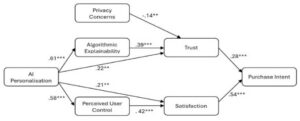
Figure 1: Model results
Source: Authors
5 Discussion
This study was designed to move beyond monolithic conceptualisations of AI personalisation by empirically testing the distinct psychological mechanisms through which it shapes consumer behaviour. Our central objective was to „unpack the black box“ by examining the mediating roles of algorithmic explainability and perceived user control. The results provide robust support for our theoretical model, confirming that these two constructs serve as crucial, yet separate, pathways linking AI personalisation to consumer trust, satisfaction, and ultimately, purchase intent.
5.1 Summary and interpretation of key findings
Our analysis of 389 active online shoppers reveals a generally positive disposition towards AI-driven e-commerce experiences. The high mean scores for AI Personalisation, Satisfaction, and Trust suggest that users find value in tailored content. The structural model demonstrated an excellent fit and accounted for a substantial portion of the variance in key outcomes, including Trust, Satisfaction, and Purchase Intent.
Most importantly, the findings illuminate two distinct psychological pathways:
Pathway 1: The cognitive route to trust via explainability
Our results confirm that AI Personalisation is a strong predictor of Algorithmic Explainability, which, in turn, is a significant driver of Consumer Trust. The partial mediation analysis substantiates that a significant portion of personalisation’s effect on trust is channelled through the user’s ability to understand the system’s logic. This finding empirically validates the core tenets of the explainable AI (XAI) and FATE (Fairness, Accountability, Transparency, and Explainability) frameworks in a consumer context. When users perceive that an AI system provides clear reasons for its recommendations, it demystifies the decision-making process. This transparency reduces uncertainty and counters the perception of the algorithm as an opaque „black box“ fostering beliefs about the system’s competence, reliability, and integrity. In essence, understanding why a recommendation was made builds the cognitive foundation necessary for trust.
Pathway 2: The affective route to satisfaction via control
Concurrently, AI Personalisation strongly predicts Perceived User Control, which is a powerful antecedent of Consumer Satisfaction. This pathway, also a partial mediation, highlights the importance of user agency. When consumers feel empowered to influence, adjust, or correct the personalisation process, their sense of autonomy is preserved. This control mitigates feelings of being manipulated and ensures the user remains an active participant rather than a passive recipient of algorithmic outputs. This aligns with Expectation-Confirmation Theory (ECT); control allows users to align the system’s output with their own expectations, leading to higher confirmation and subsequent satisfaction. The positive affective experience of being in control directly enhances the overall enjoyment and contentment with the service.
5.2 The differential impact of trust and satisfaction on purchase intent
A particularly insightful finding is the differential impact of our two key psychological outcomes on Purchase Intent. While both Trust and Satisfaction are significant positive predictors, Satisfaction has nearly double the direct influence on the intention to purchase. This suggests that in the immediate context of an e-commerce transaction, the affective and experiential quality of the interaction (satisfaction) is a more potent driver of behaviour than the cognitive evaluation of the system’s reliability (trust).
This does not diminish the importance of trust. Rather, it clarifies its role. Trust may function as a foundational prerequisite, a „licence to operate“, that enables continued engagement and willingness to share data. However, it is the moment-to-moment satisfaction derived from a relevant, controllable, and pleasant user experience that most directly converts browsing into buying. This is further supported by the partial mediation of Satisfaction on the path from AI Personalisation to Purchase Intent, indicating that much of personalisation’s commercial benefit is realised through the positive experience it creates.
5.3 The critical boundary condition: Privacy concerns
Our model’s most significant theoretical contribution may be the confirmation of Privacy Concerns as a negative moderator of the relationship between AI Personalisation and Trust. The simple slopes analysis is revealing: at low levels of privacy concern, personalisation has a strong, positive effect on trust. However, at high levels of privacy concern, this positive effect is completely nullified.
This result provides stark empirical evidence for the personalisation-privacy paradox. It demonstrates that transparency and explainability are not panaceas. No matter how well a system explains its logic, if users fundamentally distrust the underlying data collection and usage practices, trust will not be established. This finding implies that efforts to „open the black box“ through explainability are necessary but insufficient. They must be coupled with robust, transparent, and user-respecting privacy policies to be effective. When privacy concerns are salient, the benefits of personalisation are overshadowed by the perceived risks, effectively short-circuiting the cognitive pathway to trust.
5.4 Theoretical implications
This study makes several contributions that refine and extend established theories in the context of human-AI interaction:
• Extends the Technology Acceptance Model (TAM) for the AI Era: The research moves beyond the traditional TAM constructs of perceived usefulness and ease of use. It demonstrates that for complex, autonomous AI systems, new constructs reflecting the system’s opaque nature are critical. By empirically validating Algorithmic Explainability (EXP) and Perceived User Control (PUC) as essential mediating variables, the study proposes an evolved acceptance model for AI. It suggests that trust and satisfaction are not direct outcomes of system use but are complex, mediated states shaped by the user’s ability to understand (explainability) and influence (control) the algorithm.
• Refines Trust Theories in Human-AI Interaction: The model provides a more granular understanding of trust formation in AI contexts. It empirically separates two pathways: a cognitive route to trust channelled through explainability and an affective route to satisfaction channelled through control. This dissection clarifies that trust in AI is not a monolithic belief but is built on a cognitive foundation of transparency and predictability. Furthermore, the powerful moderating effect of privacy concerns shows that trust in AI systems depends not only on perceptions of their competence and ability but, more critically, on their perceived integrity and benevolence in data handling.
• Enriches Expectation-Confirmation Theory (ECT): This study adds a critical antecedent to the ECT framework in AI-driven environments. ECT posits that satisfaction results from the alignment of expectations with performance. Our findings reveal that Perceived User Control is a key mechanism that empowers users to actively manage this alignment. By giving users the agency to adjust, correct, or guide the personalisation process, control helps ensure the AI’s output meets or exceeds their expectations, thereby facilitating the positive confirmation that leads to satisfaction. This introduces a proactive, user-driven element into the traditionally passive confirmation process described by ECT.
• Provides an Empirical Model for the Personalisation-Privacy Paradox: The study moves beyond the conceptual description of the „personalisation-privacy paradox“ by operationalising and testing its boundary conditions. The confirmation of privacy concerns as a significant negative moderator of the AIP Trust relationship provides a quantitative model of the trade-off. The finding that explainability’s benefits are nullified at high levels of privacy concern demonstrates that transparency alone is an insufficient solution to the paradox. This implies that ethical AI frameworks like FATE (Fairness, Accountability, Transparency, and Explainability) must be built upon a foundational respect for privacy to be effective in practice.
5.5 Practical implications
The findings offer clear, actionable guidance for designing and managing AI personalisation systems in e-commerce. To move from theory to practice, managers and system designers should prioritise the following four strategic areas:
a) Implement a dual-feature strategy for trust and satisfaction: The research demonstrates that trust and satisfaction are built through different mechanisms and should be addressed with distinct features.
• To build trust (The Cognitive Route): Integrate clear, in-context explainability features that demystify the algorithm’s logic. Simple explanations like, „Recommended because you viewed [Product X]“, address the user’s cognitive need for transparency and reduce uncertainty.
• To drive satisfaction (The Affective Route): Provide tangible user control mechanisms that enhance agency. Features such as preference sliders, feedback buttons („show me less like this“), and accessible data dashboards empower users, directly boosting satisfaction and mitigating feelings of being manipulated.
b) Focus user experience (UX) design on satisfaction to maximise conversions: While trust is a crucial foundational element, the results show that user satisfaction has nearly double the direct influence on purchase intent.
• Prioritise experiential quality: UX design should be optimised to create seamless, relevant, and empowering interactions that generate immediate positive feelings.
• Leverage control as a satisfaction driver: Perceived control is a key lever for improving the user experience, as it allows users to align the system’s output with their own expectations, directly leading to greater satisfaction and converting browsing into buying.
c) Adopt a „Privacy-by-Design“ approach as a foundational priority: The study provides strong evidence that algorithmic transparency is ineffective if users have high privacy concerns.
• Go beyond compliance: A reactive, compliance-focused approach to privacy is insufficient. Instead, embed privacy considerations into the core of the system design.
• Communicate and empower proactively: Clearly communicate how user data is used, minimise data collection to what is essential, and provide users with meaningful, easy-to-use controls over their personal information. Failing to address privacy proactively will fundamentally undermine all other trust-building efforts.
d) Segment users and adapt the personalisation experience: The finding that frequent users perceive higher levels of control and relevance indicates that a one-size-fits-all approach is suboptimal.
• Design for the learning curve: for new users, create an adaptive onboarding process that gradually introduces personalisation features and explains how they work. This helps build an accurate mental model and fosters initial confidence.
• Cater to power users: For experienced users, offer more advanced controls and nuanced personalisation options. This creates a virtuous cycle of engagement, familiarity, and deepened trust.
5.6 Limitations and directions for future research
This study has limitations that present opportunities for future work. First, its cross-sectional design prevents definitive causal claims. Experimental studies that manipulate levels of explainability and control are needed to confirm the causal directions proposed. Second, our reliance on self-report measures is a limitation. Future studies should incorporate behavioural data (e.g., click-through rates, actual purchases, use of control features) to triangulate findings. Third, the sample was drawn from a single country (Algeria), which may limit the generalisability of the findings across different cultural and regulatory contexts. Replications in diverse markets are essential. Finally, this study conceptualises explainability as a user perception; future research could manipulate the specific types and quality of explanations provided to identify which are most effective.
6 Conclusion
In seeking to unpack the „black box“ of AI personalisation, this research demonstrates that the path from algorithmic output to consumer action is not direct. It is mediated by crucial psychological perceptions of understanding and agency.
By providing users with both algorithmic explainability to build cognitive trust and perceived control to foster affective satisfaction, businesses can transform opaque AI systems into transparent and empowering partners.
However, these efforts will only succeed if they are built on a foundation of respect for user privacy. Ultimately, the most commercially effective personalisation strategies will also be the most ethically responsible ones.
Literatúra/List of References
- Abdullah, A. A. H. and Almaqtari, F. A., 2024. The impact of artificial intelligence and Industry 4.0 on transforming accounting and auditing practices. In: Journal of Open Innovation: Technology, Market, and Complexity. 2024, 10(1), 100218. ISSN 2199-8531. Available at: <https://doi.org/10.1016/j.joitmc.2024.100218>
- Aksoy, N. C., Kabadayi, E. T., Yilmaz, C. and Alan, A. K., 2021. A typology of personalisation practices in marketing in the digital age. In: Journal of Marketing Management. 2021, (37), 1091-1122. ISSN 1472-1376. Avalaible at: <https://doi.org/10.1080/0267257X.2020.1866647>
- Bach, T. A., Khan, A., Hallock, H., Beltrão, G. and Sousa, S., 2024. A systematic literature review of user trust in AI-enabled systems: An HCI perspective. In: International Journal of Human-Computer Interaction. 2024, 40(5), 1251-1266. ISSN 1044-7318. Available at: <https://doi.org/10.1080/10447318.2022.2138826>
- Bartol, J., Prevodnik, K., Vehovar, V. and Petrovčič, A., 2024. The roles of perceived privacy control, Internet privacy concerns and Internet skills in the direct and indirect Internet uses of older adults: Conceptual integration and empirical testing of a theoretical model. In: New Media & Society. 2024, 26(8), 4490-4510. ISSN 1461-4448. Available at: <https://doi.org/10.1177/14614448221122734>
- Bauer, K., Von Zahn, M. and Hinz, O., 2023. Expl(AI)ned: The impact of explainable artificial intelligence on users’ information processing. In: Information Systems Research. 2023, 34(4), 1582-1602. ISSN 1461-4448. Available at: <https://doi.org/10.1287/isre.2023.1199>
- Bleier, A. and Eisenbeiss, M., 2015. Personalized online advertising effectiveness: The interplay of what, when, and where. In: Marketing Science. 2015, 34(5), 669-688. ISSN 0732-2399. Available at: <https://doi.org/10.1287/mksc.2015.0930>
- Buhalis, D. and Sinarta, Y., 2019. Real-time co-creation and nowness service: lessons from tourism and hospitality. In: Journal of Travel & Tourism Marketing. 2019, 36(5), 563-582. ISSN 1540-7306. Available at: <https://doi.org/10.1080/10548408.2019.1592059>
- Carabantes, M., 2020. Black-box artificial intelligence: an epistemological and critical analysis. In: AI & SOCIETY. 2020, 35(2), 309-317. ISSN 1435-5655. Available at: <https://doi.org/10.1007/s00146-019-00888-w>
- Chan, C. K. Y. and Hu, W., 2023. Students’ voices on generative AI: perceptions, benefits, and challenges in higher education. In: International Journal of Educational Technology in Higher Education. 2023, 20(1), 43. ISSN 2365-9440. Available at: <https://doi.org/10.1186/s41239-023-00411-8>
- Chandra, S., Verma, S., Lim, W. M., Kumar, S. and Donthu, N., 2022. Personalization in personalized marketing: Trends and ways forward. In: Psychology & Marketing. 2022, 39(8), 1529-1562. ISSN 1520-6793. Available at: <https://doi.org/10.1002/mar.21670>
- Chellappa, R. K. and Sin, R. G., 2005. Personalization versus privacy: An empirical examination of the online consumer’s dilemma. In: Information Technology and Management. 2005, 6(2-3), 181-202. ISSN 1573-7667. Available at: <https://doi.org/10.1007/s10799-005-5879-y>
- Choung, H., David, P. and Ross, A., 2023. Trust in AI and its role in the acceptance of AI technologies. In: International Journal of Human-Computer Interaction. 2023, 39(9), 1727-1739. ISSN 1532-7590. Available at: <https://doi.org/10.1080/10447318.2022.2050543>
- Czuprak, N. and Nemeth, R., 2025. The IKEA effect in human-AI collaboration: Does the effect exist for non-physical products? Part I. In: Marketing Science & Inspirations. 2025, 20(3), 2-6. ISSN 1338-7944. Available at: <https://doi.org/10.46286/msi.2025.20.3.1>
- Ding, Y. and Najaf, M., 2024. Interactivity, humanness, and trust: a psychological approach to AI chatbot adoption in e-commerce. In: BMC Psychology. 2024, 12(1), 595. ISSN 2050-7283. Available at: <https://doi.org/10.1186/s40359-024-02083-z>
- Ehsan, U. and Riedl, M., 2019. On design and evaluation of human-centered explainable AI systems. In: Library catalogue: Semantic Scholar, 2019. [online]. [cit. 2025-10-02]. Available at: <https://api.semanticscholar.org/CorpusID:150383566>
- Glikson, E. and Woolley, A. W., 2020. Human trust in artificial intelligence: Review of empirical research. In: Academy of Management Annals. 2020, 14(2), 627-660. ISSN 1941-6520. Available at: <https://doi.org/10.5465/annals.2018.0057>
- Gursoy, D., Chi, O. H., Lu, L. and Nunkoo, R., 2019. Consumers acceptance of artificially intelligent (AI) device use in service delivery. In: International Journal of Information Management. 2019, 49, 157-169. ISSN 0268-4012. Available at: <https://doi.org/10.1016/j.ijinfomgt.2019.03.008>
- Hardcastle, K., Vorster, L. and Brown, D. M., 2025. Understanding customer responses to AI-driven personalized journeys: Impacts on the customer experience. In: Journal of Advertising. 2025, 54(2), 176-195. ISSN 1557-7805. Available at: <https://doi.org/10.1080/00913367.2025.2460985>
- Hassan, N., Abdelraouf, M. and El-Shihy, D., 2025. The moderating role of personalized recommendations in the trust-satisfaction-loyalty relationship: an empirical study of AI-driven e-commerce. In: Future Business Journal. 2025, 11(1), 66. ISSN 2314-7210. Available at: <https://doi.org/10.1186/s43093-025-00476-z>
- Hong, I. B. and Cha, H. S., 2013. The mediating role of consumer trust in an online merchant in predicting purchase intention. In: International Journal of Information Management. 2013, 33(6), 927-939. ISSN 0268-4012. Available at: <https://doi.org/10.1016/j.ijinfomgt.2013.08.007>
- Hossain, M. A. and Quaddus, M., 2012. Expectation-confirmation theory in information system research: A review and analysis. In: Integrated series on information systems. 2012. ISBN 978-1-4419-6107-5.
- Kebab, M., 2025. Travel app adoption intentions: Extending the technology acceptance model with trust. In: Marketing Science & Inspirations. 2025, 20(2), 45-58. ISSN 1338-7944. Available at: <https://doi.org/10.46286/msi.2025.20.2.4>
- Khuat, T. T., Kedziora, D. J. and Gabrys, B., 2022. The roles and modes of human interactions with automated machine learning systems. 2022. In: arXiv. [online]. [cit. 2025-10-02]. Available at: <https://doi.org/10.48550/arXiv.2205.04139>
- Kim, M. J., Kim, M. J., Hall, C. M. and Hall, C. M., 2021. Do value-attitude-behavior and personality affect sustainability crowdfunding initiatives? In: Journal of Environmental Management. 2021. ISSN 1095-8630. Available at: <https://doi.org/10.1016/j.jenvman.2020.111827>
- Kozyreva, A., Lorenz-Spreen, P., Hertwig, R., Lewandowsky, S. and Herzog, S. M., 2021. Public attitudes towards algorithmic personalization and use of personal data online: evidence from Germany, Great Britain, and the United States. In: Humanities and Social Sciences Communications. 2021, 8(1). ISSN 2662-9992. Available at: <https://doi.org/10.1057/s41599-021-00787-w>
- Laki, K. and Miklosik, A., 2025. Leveraging AI-powered social media platforms to enhance customer engagement and drive sales growth in Uganda’s SMEs. In: Marketing Science & Inspirations. 2025, 20(3), 46-58. ISSN 1338-7944. Available at: <https://doi.org/10.46286/msi.2025.20.3.5>
- Maier, C., Thatcher, J., Grover, V. and Dwivedi, Y. K., 2023. Cross-sectional research: A critical perspective, use cases, and recommendations for IS research. In: International Journal of Information Management. 2023, 70, 102625. ISSN 0268-4012. Available at: <https://doi.org/10.1016/j.ijinfomgt.2023.102625>
- Mechta, M., Mouloudj, K., Bouarar, A., Bovsh, L. and Rasulova, A., 2024. Customers’ intentions to adopt digital health services: An extended TAM. In: Marketing Science & Inspirations. 2024, 19(4), 2-16. ISSN 1338-7944. Available at: <https://doi.org/10.46286/msi.2024.19.4.1>
- Moody, G., Lowry, P. and Galletta, D., 2017. It’s complicated: explaining the relationship between trust, distrust, and ambivalence in online transaction relationships using polynomial regression analysis and response surface analysis. In: European Journal of Information Systems. 2017. ISSN 0960-085X. Available at: <https://doi.org/10.1057/s41303-016-0027-9>
- Oyekunle, D., Matthew, U. O., Preston, D. and Boohene, D., 2024. Trust beyond technology algorithms: A theoretical exploration of consumer trust and behavior in technological consumption and AI projects. In: Journal of Computer and Communications. 2024, 12(6), 72-102. ISSN 2327-5227. Available at: <https://doi.org/10.4236/jcc.2024.126006>
- Radanliev, P., 2025. AI ethics: Integrating transparency, fairness, and privacy in AI development. In: Applied Artificial Intelligence. 2025, 39(1), 2463722. ISSN 1087-6545. Available at: <https://doi.org/10.1080/08839514.2025.2463722>
- Rai, A., 2020. Explainable AI: from black box to glass box. In: Journal of the Academy of Marketing Science. 2020, 48, 137-141. ISSN 0092-0703. Available at: <https://doi.org/10.1007/s11747-019-00710-5>
- Ramasamy, G., Ramasamy, G. D. and Ramasamy, P., 2024. Conceptual review of consumer satisfaction theories with expectation-confirmation and disconfirmation paradigm for business sustainable growth and decision making. In: F1000Research. 2024. [online]. [cit. 2025-10-02]. Available at: <https://doi.org/10.12688/f1000research.158612.1>
- Rane, J., Kaya, Ö., Mallick, S. K. and Rane, N., 2024. Enhancing black-box models: Advances in explainable artificial intelligence for ethical decision-making. 2024. In: Future Research Opportunities for Artificial Intelligence in Industry 4.0 and 5.0, pp. 136-180. Deep Science Publishing. ISBN 978-81-981271-0-5.
- Renjith, S., Sreekumar, A. and Jathavedan, M., 2020. An extensive study on the evolution of context-aware personalized travel recommender systems. In: Information Processing and Management. 2020. ISSN 0306-4573. Available at: <https://doi.org/10.1016/j.ipm.2019.102078>
- Roy, R. M, 2024. An e-commerce recommendation system based on dynamic analysis of customer behavior. In: International Journal for Research in Applied Science and Engineering Technology. 2024, 12(11), 37-48. ISSN 2321-9653. Available at: <https://doi.org/10.22214/ijraset.2024.64867>
- Salih, L., Tarhini, A. and Acikgoz, F., 2025. AI-enabled service continuance: Roles of trust and privacy risk. In: Journal of Computer Information Systems. 2025, 1-16. ISSN 0887-4417. Available at: <https://doi.org/10.1080/08874417.2025.2452544>
- Schelenz, L., Segal, A. and Gal, K., 2020b. Best practices for transparency in machine generated personalization. In: Adjunct Publication of the 28th ACM Conference on User Modeling, Adaptation and Personalization. Online. Genoa Italy: ACM. 14 July 2020, 23-28. ISBN 978-1-4503-7950-2.
- Shin, D., 2020. User perceptions of algorithmic decisions in the personalized AI system: Perceptual evaluation of fairness, accountability, transparency, and explainability. In: Journal of Broadcasting & Electronic Media. 2020, 64(4), 541-565. ISSN 0883-8151. Available at: <https://doi.org/10.1080/08838151.2020.1843357>
- Shin, D., 2021. The effects of explainability and causability on perception, trust, and acceptance: Implications for explainable AI. In: International Journal of Human-Computer Studies. 2021, 146(102551). ISSN 1071-5819. Available at: <https://doi.org/10.1016/j.ijhcs.2020.102551>
- Shin, D. D., Zhong, B. and Biocca, F., 2020. Beyond user experience: What constitutes algorithmic experiences?. In: International Journal of Information Management. 2020, 52, 102061. ISSN 0268-4012. Available at: <https://doi.org/10.1016/j.ijinfomgt.2019.102061>
- Sipos, D., 2025. The effects of AI-powered personalization on consumer trust, satisfaction, and purchase intent. In: European Journal of Applied Science, Engineering and Technology. 2025, 3(2), 14-24. ISSN 2786-9342. Available at: <https://doi.org/10.59324/ejaset.2025.3(2).02>
- Sudirjo, F., 2024. The effect of shopping experience and store design on customer satisfaction at malls in Jakarta. In: Sciences du Nord Economics and Business. 2024, 1(2). ISSN 3047-5643. Available at: <https://doi.org/10.58812/sneb.v1i2.31>
- Sundar, S., 2020. Rise of machine agency: A framework for studying the psychology of human-AI interaction (HAII). In: Journal of Computer-Mediated Communication. 2020, 25(1). ISSN 1083-6101. Available at: <https://doi.org/10.1093/jcmc/zmz026>
- Tarnanidis, T., 2023. Understanding reference points to make purchase decisions: overview, phases, and time-features. In: Marketing Science & Inspirations. 2023, 18(4), 2-13. ISSN 1338-7944. Available at: <https://doi.org/10.46286/msi.2023.18.4.1>
- Thiebes, S., Lins, S. and Sunyaev, A., 2021. Trustworthy artificial intelligence. In: Electronic Markets. 2021, 31(2), 447-464. ISSN 1422-8890. Available at: <https://doi.org/10.1007/s12525-020-00441-4>
- Thurman, N., Moeller, J., Helberger, N. and Trilling, D., 2019. My friends, editors, algorithms, and I: Examining audience attitudes to news selection. In: Digital journalism. 2019, 7(4), 447-469. ISSN 2167-082X. Available at: <https://doi.org/10.1080/21670811.2018.1493936>
- Valenzuela, A., Puntoni, S., Hoffman, D., Castelo, N., De Freitas, J., Dietvorst, B., Hildebrand, C., Huh, Y. E., Meyer, R., Sweeney, M. E., Talaifar, S., Tomaino, G. and Wertenbroch, K., 2024. How artificial intelligence constrains the human experience. In: Journal of the Association for Consumer Research. 2024, 9(3), 241-256. ISSN 2378-1815. Available at: <https://doi.org/10.1086/730709>
- Wanner, J., Herm, L.-V., Heinrich, K. and Janiesch, C., 2022. The effect of transparency and trust on intelligent system acceptance: Evidence from a user-based study. In: Electronic Markets. 2022, 32(4), 2079-2102. ISSN 1422-8890. Available at: <https://doi.org/10.1007/s12525-022-00593-5>
- Wolf, E. J., Harrington, K. M., Clark, S. L. and Miller, M. W., 2013. Sample size requirements for structural equation models: An evaluation of power, bias, and solution propriety. In: Educational and Psychological Measurement. 2013, 76(6), 913-934. ISSN 0013-1644. Available at: <https://doi.org/10.1177/0013164413495237>
- Yang, R. and Wibowo, S., 2022. User trust in artificial intelligence: A comprehensive conceptual framework. In: Electronic Markets. Online. 2022, 32(4), 2053-2077. ISSN 1422-8890. Available at: <https://doi.org/10.1007/s12525-022-00592-6>
- Yin, J., Qiu, X. and Wang, Y., 2025. The impact of AI-personalized recommendations on clicking intentions: Evidence from Chinese e-commerce. In: Journal of Theoretical and Applied Electronic Commerce Research. 2025, 20(1), 21. ISSN 0718-1876. Available at: <https://doi.org/10.3390/jtaer20010021>
- Zeithaml, V., Parasuraman, A. and Malhotra, A., 2002. Service quality delivery through web sites: A critical review of extant knowledge. In: Journal of the Academy of Marketing Science. 2002. ISSN 0092-0703. Available at: <https://doi.org/10.1177/009207002236911>
Kľúčové slová/Key words
AI personalisation, algorithmic explainability (XAI), perceived user control, purchase intent, privacy concerns, black box algorithms
personalizácia pomocou umelej inteligencie, vysvetliteľnosť algoritmov (XAI), vnímaná kontrola zo strany používateľa, nákupný zámer, obavy o súkromie, algoritmy typu „čierna skrinka“
JEL klasifikácia/JEL Classification
D82, L81, L86, M31, C83
Résumé
Rozbalenie čiernej skrinky: Ako algoritmická transparentnosť a kontrola zo strany používateľov ovplyvňujú dôveru, spokojnosť a nákupné zámery v ére umelej inteligencie
Táto štúdia skúma „paradox personalizácie a súkromia“ v elektronickom obchode poháňanom umelou inteligenciou, kde spotrebitelia oceňujú personalizované zážitky, zároveň však rastie ich obava z rozsiahleho zberu údajov algoritmami typu „čierna skrinka“. Výskum sa zameriava na kritickú medzeru v pochopení toho, ako algoritmická transparentnosť a kontrola zo strany používateľa ovplyvňujú reakcie spotrebiteľov na personalizáciu prostredníctvom umelej inteligencie, čím prekračuje monolitické chápanie systémov umelej inteligencie. Pomocou modelovania štrukturálnych rovníc s 389 online nakupujúcimi z Alžírska táto štúdia empiricky testuje odlišné sprostredkovateľské úlohy vysvetliteľosti algoritmov a vnímanej kontroly používateľa. Kvantitatívny prierezový prieskum využíval validované meracie škály na preskúmanie vzťahov medzi premennými. Kľúčové zistenia odhaľujú dve odlišné cesty: vysvetľovanie buduje kognitívnu dôveru prostredníctvom transparentnosti, zatiaľ čo vnímaná kontrola zvyšuje spokojnosť prostredníctvom autonómie používateľa. Spokojnosť vykazuje takmer dvojnásobný priamy vplyv na nákupný zámer v porovnaní s dôverou. Kľúčové je, že vysoké obavy o súkromie úplne rušia pozitívne účinky personalizácie na dôveru. Tieto výsledky ukazujú, že eticky zodpovedné stratégie personalizácie musia integrovať vysvetliteľnost algoritmov aj kontrolu používateľa s robustnými postupmi v oblasti ochrany súkromia, keďže
Recenzované/Reviewed
13. October 2025 / 26. November 2025