



1 Introduction
Creativity and innovation have become critical success factors in dynamic and competitive environments, especially in sectors such as agro-food. Creativity represents the ability to generate novel and valuable ideas, whereas innovation refers to the successful implementation of those ideas into products or services. Although closely related, these concepts have distinct characteristics and should not be used interchangeably. In this way, creativity is generally associated with ideation and imagination, while innovation emphasizes execution, market viability, and value creation.
According to the psychoanalytic approach (Freud 1958), creativity is the result of the interaction between conscious reality and unconscious impulses. For the psychometric approach (Torrance 1974), creativity is a quality not restricted to an individual (Guilford 1950). The systemic approach (Csikszentmihalyi and Gardner 1994), creativity results from the combination of the individual, the field, and the domain. Similarly, the mystical approach (Runco 1999; Sternberg and Lubart 1999) associate creativity with aesthetic, expressive, and artistic outcomes. Furthermore, the cognitive approach (Sternberg and Lubart 1999) focuses on cognitive skills and the process of creative thinking.
Finally, the multivariate approach to creativity (Lubart et al. 2003) views creativity as the result of the convergence of four aspects: cognitive, conative, emotional, and environmental. According to Aznar (2009), creativity is a process set in motion to develop new ideas or provide innovative solutions to a problem or challenge (conceptual, technical, commercial, social, etc.).
Kao (1996), Mohanty (1999), and Özsmer (1997) view creativity as a source of efficiency in guiding marketing and research and development (R&D) activities. Consequently, innovating without creativity results in the launch of minimally original innovative products, leading to costly marketing budgets with a high risk of failure and significant financial consequences for companies. The challenge for businesses is to find new ideas and convert them into innovative concepts through methods and tools designed to improve, organize, and facilitate creativity (Gotteland, Haon and Boule 2017).
In Algeria, the agro-food industry includes over 31,557 companies with more than 170,000 employees (ONS 2023). Production in the agro-food industries continues to grow, with a variation of +3.7% during the first quarter of 2023. Today, agro-food companies are facing an economic situation (inflation and decreased purchasing power) brought about by the effects of the health crisis and political and economic decisions (reduction in raw material imports). As a result, these companies face the challenge of attracting and retaining customers and stimulating the needs of new consumers to drive purchasing behaviour. Therefore, the issue of creativity and innovation has become central to these companies’ concerns in order to generate new ideas and transform them into innovative products and solutions that create value for customers. This highlights the importance of directing marketing research towards understanding the mechanisms and structure of creativity within agro-food companies and determining the appropriate tools and methods for developing innovative products. To address this, we have formulated the following question:
How does creativity contribute to the development of innovative products within Algerian agro-food companies?
From this main question, the following sub-questions arise:
• What techniques are used to enhance creativity within companies?
• What is the relationship between the process of creativity and the process of innovation within Algerian agro-food companies?
To address our research questions, we have chosen the multivariate approach to creativity as the theoretical framework (Sternberg and Lubart 1999) and the „Creative Problem Solving“ (CPS) process (Parnes and Osborn 1992). In this context, improving creativity can lead to more competitive, consumer-focused products. Accordingly, this paper introduces a model of creativity in product innovation using the SADT method combined with the CPS model.
Our study does not aim to create an exhaustive list of creativity tools and methods leading to product innovation, our objective is to: identify the motivations and constraints associated with implementing a creativity approach and simulate a model of the process of creativity linked to the process of the development of the innovative products within Algerian agro-food companies. To achieve this, we have opted for an anasynthesis approach within a qualitative iterative framework developed in seven stages (Legendre 2005, p. 74).
2 Research objectivesn
This study aims to examine how creativity is integrated into the product innovation process within an Algerian agro-food company. The objective is to develop a model that captures the interaction between creative thinking and structured product development in a practical business context.
The research takes a multidisciplinary approach, focusing on the complementarity between engineering-oriented R&D activities and the psychological and organizational dimensions of creativity. It also seeks to identify the key variables necessary for building a relevant and effective model. Specifically, the study seeks to:
• Identify the motivations for and challenges in implementing creativity methods within the company.
• Understand how creativity and innovation are linked in practical, real-world settings.
• Develop a structured process model based on the SADT (Structured Analysis and Design Technique) and CPS (Creative Problem Solving) frameworks.
• Assess how useful and relevant this model would be in a real company setting.
3 Theoretical background
The development of innovative products primarily revolves around two main axes: the process of innovation and creativity, and the combination of these two processes.
3.1 Creativity according to the multivariate approach
The literature review of different approaches to the process of creativity has revealed the existence of divergent definitions of the concept as well as factors influencing their organization within companies. However, the definition of creativity that is widely accepted is that of Sternberg and Lubart (1995), cited by Sternberg (1999 p. 35): „Creativi-ty is the ability to produce something that is both new and appropriate to the context in which it manifests“.
Lubart (1999) considers creativity as the result of four factors: cognitive, conative, emotional, and environmental. It explains creativity through the joint and interactive influence of individual, cognitive, and conative characteristics (intellectual or personal aptitudes), and the environmental context (culture, family, and organizational environment) on creative potential. Consequently, the result of creative production varies according to the context.
Creativity is viewed by Lubart (1995) and Drazin et al. (1999) as both a process and an outcome. They explain creative production through two dimensions: the first involves the generation of new ideas („insight“) through mental processes that encompass mental mechanics and emotional energy. The second involves producing solutions by transforming the ideas generated through the process of creativity into operational solutions suited to given contexts.
In marketing research, creativity involves the skills and abilities developed through methods and tools. It is closely linked to motivation, emotion, and personality factors (Pradhan et al. 2017). This underscores the importance of exploring the process of creativity and the use of tools and methods for idea generation and problem-solving.
Amabile (1996) was the first to propose a model of creativity within organizations. She defines creativity as the result of the interaction between organizational and individual factors. This interaction provides the company with a high level of productivity, leading to the emergence of new ideas and their transformation into solutions.
Moreover, developing emerging ideas into business opportunities in a given context can involve: the combination of the process of creativity and the process of innovation. To explain the mechanism of integrating creativity within the innovation process, we refer to the CPS model for creativity and the Stage-Gate System model for innovation.
In this study, creativity is defined following Sternberg and Lubart (1999) as the capacity to produce work that is both novel and appropriate. The research the (CPS) model developed by Parnes and Osborn (1992), with comprise stage of problem identification, idea generation and implementation planning.
3.2 The CPS process of creativity mode
The CPS process used in this research consists of three phases: the first is a thorough consideration of the problem, the second is the transformation of ideas into innovative solutions tailored to the encountered problems, and finally, the third is the implementation of an action plan to develop the solution into an innovative product (Aznar 2012). These three phases are further divided into eight steps by Wolfe (2007). According to her, „…with these steps of intuitive production and constructive analysis, the creative process is both a structured and flexible method that allows for traversing all phases of concept creation or problem resolution by integrating creativity in an operational manner“, as cited by Aznar (2014 p. 28). Each step of the CPS process involves two alternating phases: divergence, which is a projection into the imagination of the right hemisphere of the brain (intuitive thinking), and convergence, which is the alignment of imagination with the constraints of reality, representing the left hemisphere of the brain (logical, analytical, and evaluative thinking), as illustrated in Figure 1.
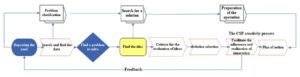
Figure 1: Phases of the CPS model
Source: Authors according to Creative Education Foundation (2014)
3.3 Innovation models: The „Stage-Gate System“ process of innovation model by Cooper (1990)
Innovation involve a systematic process of transforming creative ideas into market-ready products. Cooper’s Stage-Gate model (1990) is wisely adopted in industry and consists of five stages: idea screening, development, validation, launch preparation and commercialization.
The model Stage-Gate System process (Cooper 1990) includes all stages of the development and launch of new products (Figure 2). At the end of each stage, deliverables are presented related to the functions of the company: marketing, engineering, production, quality, sales, etc.
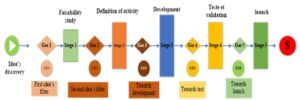
Figure 2: The stages of the stage-gate system process
Source: Cooper (1990, p. 45)
This process is divided into five distinct stages, referred to as „stages“ which are consecutive and include:
1. The first phase of preliminary evaluation: technical study, commercial feasibility, and market attractiveness.
2. The second phase of definition: study of project attractiveness before the development phase.
3. The third phase of development: involves product development alongside various marketing test plans, and financial analysis.
4. The fourth phase: encompasses all product viability tests, including product concept, production process, customer acceptance, and project economic aspects.
5. The fifth phase: commercialization of the product, which involves implementing the launch marketing plan and operational plan.
These stages are separated by „gates“, which represent decision-making phases based on evaluation meetings concerning:
• Economic feasibility („profitability and overall investment cost“).
• Technical feasibility (quality and production).
• Commercial feasibility and team management.
Consistent with this approach, innovative packaging (labelled in Braille) has great impact on attitude and purchase intention of the visually impaired consumers in Algeria (Sahel et al. 2022), proving product features are not limited to functionalities but extend toward perceptual/accessibility aspects.
4 Methodology
This study employs a qualitative explanatory approach through an in-depth case study. The research was conducted within a major agro-food company located in Algeria, from January 2022 to October 2023. For reasons of confidentiality, the company remains anonymous. Also, Laoudj, Krim and Bouchetara (2024) investigated how artisans working in the clusters of Constantine and Batna activate factors namely technology, talent and tolerance to engage in innovative activity into the production of their craft goods. Their results show that also in more conventional industries, stakeholders still see a need for product innovation, which is obtained by regional collaboration.
4.1 The research phases
The study follows a longitudinal process divided into four distinct phases:
1. First period (January to March 2022): Non-directive interviews were conducted with the directors of Purchasing and Supply, Production, and Supply Chain. Additionally, working sessions lasting 2 to 3 hours were held with the marketing product manager to gain insights into the concept of the new product.
2. Second period (April to August 2022): This period focused on the development and testing of the recipe for the new product.
3. Third period (September to November 2022): Testing of the product, including the recipe and packaging, was carried out.
4. Fourth period (December 2022 to February 15, 2023): This period involved the launch of production and the beginning of commercialization.
4.2 Data collection and processing method
To gather the data required for our research, we employed a triangulation of methods, including an interview guide, participatory observation, and analysis of internal company documents.
The interview guide is structured around three main axes: the first axis addresses perceptions (motivations and barriers) regarding the integration of creativity; the second axis focuses on the creativity tools and methods implemented within the organization; and the third axis examines the contribution of these methods and tools to the development of innovative products.
Participatory observation was conducted using an observation grid that encompasses the phases of the product innovation process according to the Stage-Gate System model. Finally, we analyzed internal company documents, including the recipe creation and modification flowchart, design briefs (R&D), and prototype briefs and macro planning for research and development (R&D).
For data processing, we relied on both content analysis of the interviews and process analysis.
To model creativity, we drew inspiration from both the theoretical model of innovation, the „Stage-Gate System“ developed by Cooper (1990), and the graphical method, SADT (Ross 1977) (Figure 3).
4.3 The structured analysis and design technique (SADT)
SADT is a modelling method that involves functional analysis from a high level („A-0“) down to more specific and detailed levels („Aijk“). It is suitable for modelling activities and information flows in the form of an activity diagram, which transforms raw input data into output data. Activities are subject to control instructions (company’s strategic objectives) while leveraging the potential of the activity support (creativity methods and tools).
5 Results and discussion
Results analysis enabled us to model the creativity process for company „X“ by following the steps involved in he creation of the new product „Y“. We have termed this proposed creativity process the „micro model“.
5.1 The creativity approach followed by company „X“
Regarding creativity within company „X“, we observed that the concept of creativity is often conflated with that of innovation.
5.1.1 Creativity within company „X“
According to the Marketing Product Manager, „…creativity to me is the same as innovation“. For the Director and Research and Development Engineer, „creativity involves external monitoring, benchmarking, and an internal idea box for the development of new products“. The Marketing and Sales Director describes creativity as „the development of new ideas“. In contrast, the Quality Director defines creativity as „both the development and creation of new ideas, as well as the resolution of problems in a creative manner“.
Additionally, we observed that managers within company „X,“ specifically the Director of Research and Development and the Quality Director, are aware of the importance of integrating creativity into the new product development process. Since the company has shifted towards an innovation orientation, new operational modes have been adopted, and some are beginning to be formalized. However, a structured creativity process has not yet been established within company „X“. We noted a divergence in the perception and interpretation of creativity and innovation within the studied company. Some interviewed leaders view them as similar, while others see them as complementary. Despite this difference, the company’s leaders agree on the importance of creativity in generating new ideas and transforming them into innovative products.
5.2 Prototype of the creativity model involved in product innovation at company „X“
The simulated model of the creativity process, based on the SADT method, aligns with the stages of the CPS process. We have added a fourth stage, observed during our participatory observation, which is the solution development phase for product „Y“.
Figure 3, labelled „Level A0“, illustrates the main function of the creativity process in developing a new product „Y“. The activity supports include the various functions within company „X“, the phases of the overall product innovation process, and the creativity tools and methods utilized during the innovation phases. The control data consists of the company’s objectives.
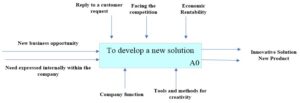
Figure 3: Representation of the main function of the creativity process.
Source: Authors
We structured the stages of the creativity process for company „X“ (Figure 4) after cross-referencing the results from the interview analysis and the monitoring of the development stages of the new product „Y“.
Figure 4: Micro model of the creativity process applied to company „X“
Source: Authors
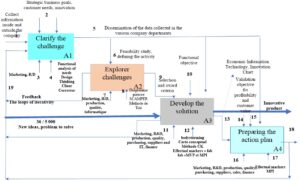
A1. Clarify the challenge: This phase is divided into three steps:
• A11. Identify the need: Company „X“ aims to create novelty to enhance its brand image, expand its product range, optimize its raw materials, improve the profitability of a production line, and achieve competitive differentiation through the development of product „Y“. To address this, the company „X“ has undertaken the following:
i. Collection of external information: This includes monitoring (political, economic, social, cultural, technological, competitive, legal, and environmental) and market analysis reports from the company.
ii. Conducting meetings between the general manager and various directors of the company that aim to translate blocking points into new challenges. This information is disseminated and communicated to different functions within the company.
• A12. Data gathering: At company „X“, the marketing department conducts research related to the objectives set by the general management. It relies on market studies conducted by external agencies to identify influences and trends in the target market, as well as ideas from the company’s internal idea box. The collected data is considered as sources of creativity.
• A13. Formulate the challenge: The collected data is consolidated by the marketing team to formulate the problem to be addressed in the idea generation workshop. The report is prepared by the product manager and validated by the marketing director. Idea Generation Workshop: This is a collective creativity method managed and facilitated by the marketing team. Based on brainstorming techniques, the workshop is organized as follows:
Participants are divided into four (4) heterogeneous groups of six (6) employees from different functions within company „X“ (marketing, research and development, quality, production, supply chain, sales, and purchasing) for a duration of 1.5 hours. The agenda is the problem to be solved, formulated as a „marketing insight“. From this insight, groups propose three to four ideas, which are then subjected to a vote to select the top three ideas.
The methods used include: brainstorming and SCAMPER, based on divergence, followed by voting on convergent criteria. These methods help translate the „marketing insight“ into new proposals.
The analysis of the idea discovery phase for the new product „Y“ enabled us to model the first phase of the creativity process based on the creativity tools and methods applied by company „X“ and inspired by experiences from companies in the same sector. We proposed integrating new methods, including crowdsourcing (as applied by the Algerian agro-food company Hamoud Boualem), design thinking (as implemented by the leading Algerian dairy company Soummam), and artificial intelligence (as used by the major Algerian dairy company Tchin-Lait). We also supplemented this model with functional analysis methods (e.g., the „Horned Beast“ and „Octopus Diagram“) to better articulate the various functions of the new product „Y“.
A2. Exploration phase of selected ideas. The three selected ideas are outgoing data listed in the idea generation workshop report. Actions are taken to explore the selected idea that could potentially solve the insight. Creativity methods applied include:
• Divergence phase: Discovery matrix, morphology matrix.
• Convergence phase: SWOT innovation matrix, lateral thinking (questions, paradoxes, provocations, operations).
During this phase, the product manager develops a project design brief for the new product „Y“. The brief is created collaboratively between the marketing product manager and project stakeholders. The decision to develop product „Y“ is made by the validation committee (CODEV) after appropriate technical, financial, and commercial evaluations aligned with the company’s expectations and market needs.
A3. Develop the solution. Following the validation of the new product „Y“ project, it is translated into a product concept. The design and validation of the product „Y“ recipe are carried out collaboratively between marketing and research and development. The creation of the prototype (design, packaging) for product „Y“ results from this stage. Creativity tools used include: TRIZ method, conceptual maps, C.K. method, effectual markers „fablab“, MVP, and MPI.
A4. Prepare the action plan. This step has not yet been analyzed in detail as the development phase is not yet complete.
6 Discussion of results
The results from observing the new product development process and creativity, along with the content analysis of interviews conducted with managers at the Algerian company „X“, have provided insight into the literature related to our issue, which reveals a divergence in the description of the process applied by the company.
Our findings indicate that the creativity process integrated into new product development is generally conducted in a sequential manner. Contrary to theoretical results, some stages are carried out simultaneously with feedback loops and bidirectional arrows. At the observed company, there are interactions between different functions marketing, research and development, production, and quality control that require iterations between product development and testing.
However, we observed a nonlinear path for the three stages: „expression of need“, „idea generation“, and „recipe development“. This is explained by the need to develop new products that align with both the company’s strategic perspectives and the dynamic market trends and evolution. Furthermore, this collaboration ensures that customer needs are integrated throughout the new product process, which is in line with the company’s overall strategy, including having a dedicated chair in each meeting room for a representative customer (whose presence is symbolic). It is noted that Fratričová, Überwimmer and Füreder (2018) and Gotteland and Haon (2011) indicated that interactive collaboration among development teams contributes to their performance.
The advantage of the Stage-Gate System (SGS) combined with CPS lies in the sequential nature of creativity. Our results contradict the notion that large companies formulate and structure the creativity process formally. The observed company only formalizes the development phase through the „creation and modification of the recipe“ procedure, while other phases are conducted informally. Beyond describing the new product development process, this case study allowed us to identify the tools and methods of creativity. We highlighted the contribution of each creativity tool and method at each phase of the SGS process.
The results do not confirm the conclusions of Chang and Taylor (2016) and Goglio-Primard et al. (2020), which state that involving customers throughout the new product development process enhances financial performance and accelerates time to market. Our observations indicate that customer involvement occurs only during the testing phase of the recipe and concept. Regarding the study of customer needs, it is carried out by an external market research agency at the company’s request. Beyond process description, the content analysis of interviews revealed a contradiction in managers’ discourse concerning the importance of project costs versus customer needs. This situation leads to marketing myopia, despite the company’s commitment to total quality.
Therefore, we propose modeling the development and creativity process to enable company „X“ to develop a new product that provides solutions for target customers. The proposed model highlights the relationship between innovation and creativity through the integration of divergent and convergent creativity tools at each stage of the SGS within company „X“. This integration ensures that customer needs are incorporated at different phases of the new product development process. Combining agile creativity methods (such as design thinking) with industrial engineering methods (such as functional need analysis) will facilitate faster time to market and reduce commercial failure. Iterative loops ensure the reliability and adaptation of the new product’s value proposition to the expectations of users and stakeholders within the studied company.
Moreover, based on the results of Cohard et al. (2020) and Fratričová, Überwimmer and Füreder (2018) we recommend that managers of large companies integrate agile creativity methods within the new product development process. Specifically, adopting a co-creation approach through open innovation practices like crowdsourcing for emerging innovative ideas and the Design Thinking process for developing rapid and effective innovative solutions (Dampérat et al. 2019). Additionally, the results of Cooper (2016 2018) encourage industrial companies to adopt a hybrid SGS process. But as Sahel et al. (2022) observe, even a significant innovation such as Braille packaging is limited in regard to perception, cost, and acceptability. This aligns with the restrictions that we identified in our case study firm to the formal implementation of tools for creativity.
7 Conclusion
This study contributes to a better understanding of the creativity process within product innovation by modelling the interaction between creative methods and structured development processes. The proposed framework, based on SADT and CPS integration, offers practical value for companies aiming to institutionalize creativity and align it with their innovation strategies. While the findings are promising, further validation and refinement are necessary to address limitations and improve the model’s robustness and transferability.
Theoretical contribution
The research results reveal that utilizing creativity tools and methods at different stages of innovation facilitates the integration of customer needs and expectations throughout the development process. These methods and tools foster better cooperation among the project team, which enhances productivity and increases stakeholder motivation in the innovation project, thereby improving the overall creative potential within the company.
Methodological contribution
Through the exploratory study, we observed that managers are aware of the importance of creativity in identifying consumer needs, developing new innovative ideas, and guiding the innovation process. However, structurally, it remains informal. Consequently, decisions made during development often lack a holistic perspective, impacting investment costs and project value. As a result, the company sometimes faces situations where the integration of or consultation with a stakeholder in the development project is overlooked. This underscores the relevance of modeling the creativity process associated with product innovation.
Managerial contribution
Implementing the proposed creativity model allows for the identification of cause-and-effect relationships between decisions made at each „gate“ and their impact on the „stages“ through an iterative loop system. This model demonstrates the value of combining industrial engineering methods, such as functional need analysis, with agile creativity methods to develop commercially successful innovations.
Research perspectives
This study opens avenues for future research that will enrich the investigation conducted by expanding the sample size. A quantitative approach would be valuable to test and validate the process generated by our study. Additionally, simulating this process through an integrated software solution could improve decision-making during the development of new products.
Finally, our study has limitations related to the qualitative nature of the collected data. We lack quantifiable data to measure the contribution of each identified tool to the performance of emerging ideas.
Literatúra/List of References
- Abdellatif, T., Slama, Y. and Mokni, H., 2017. Analysis of the relationship between cross-effects of innovation, innovativeness, and managerial effectiveness. In: Question(s) de Management. 2017, 2, 85-100. ISSN 2269-8333.
- Agriantoni, C., 2018. Markets, products, and innovation. In: Balkan Papers. 2018, 45, 1/12. ISSN 2545-4135.
- Amabile, T. M., Conti, R., Coon, H., Lazenby, J. and Herron, M., 1996. Assessing the work environment for creativity. In: Academy of Management Journal. 1996, 39(5), 1154-1184. ISSN 1948-0989. Available at: <https://doi.org/10.2307/256995>
- Aznar, G., 2009. Clarifying the meaning of the term „creativity“. In: Synergies Europe. 2009, 4, 109-118. ISSN 1951-6088.
- Cadieux, L., Carrier, C. and Gélinas, S., 2011. Creativity and management: Ideas in service of innovation. In: International Review of SME Economics and Management. 2011, 26(3-4), 7-25. ISSN 1918-9222.
- Cohard, P. and Messeghem, K., 2020. Agility and innovation: Management of organizational technologies. In: Journal of Innovation Economics & Management. 2020, 10(1), 59-70. ISSN 2032-5355. Available at: <https://doi.org/10.3917/jie.pr1.0059>
- Cohendet, P., Le Bas, C., Simon, L. and Szostak, B. L., 2013. Managing creativity. In: Management. 2013, 38(3), 5-24. ISSN 1846-3363. Available at: <https://doi.org/10.3917/mana.163.0005>
- Cooper, R. G., 1990. Stage-gate systems: A new tool for managing new products. In: Business Horizons. 1990, 33(3), 44-54. ISSN 1873-6068. Available at: <https://doi.org/10.1016/0007-6813(90)90040-I>
- Cooper, R. G. and Sommer, A. F., 2016. The agile-stage-gate hybrid model: A promising new approach and a new research opportunity. In: Journal of Product Innovation Management. 2016, 33(5), 513-526. ISSN 1540-5885. Available at: <https://doi.org/10.1111/jpim.12314>
- Cova, B., 1994. Design, marketing, and R&D in the European industry. HAL archives ouvertes. 1994. [online]. [cit. 2025-02-11]. Available at: <https://halshs.archives-ouvertes.fr/halshs-02926722>
- Creative Education Foundation., 2014. Creative problem-solving resource guide. Buffalo, NY: Creative Education Foundation, 2014.
- Dampérat, M., Jeannot, F., Jongmans, E. and Jolibert, A., 2019. Modeling a co-creativity process based on design thinking. HAL Archives Ouvertes. 2019. [online]. [cit. 2025-02-11]. Available at: <https://halshs.archives-ouvertes.fr/halshs-02063469>
- Debois, F., Groff, A. and Chenevier, E., 2015. The creativity toolbox. Dunod, 2015. ISBN 9782100723202.
- Durand, R., 2006. Organizational creativity. In: Revue Française de Gestion. 2006, 161(2), 91-94. ISSN 1777-5663. Available at: <https://doi.org/10.3166/rfg.161.91-94>
- Fratričová, A., Überwimmer, M. and Füreder, R., 2018. Service innovation processes in SMEs in Upper Austria. In: Journal of Small Business Management. 2018, 56(S1), 174-188. ISSN 1540-627X. Available at: <https://doi.org/10.1111/jsbm.12488>
- Gallen, C. and Pantin-Sohier, G., 2012. Design and marketing of food products: What are the innovation prospects? In: Innovations. 2012, 37(1), 13-29. ISSN 2603-3771. Available at: <https://doi.org/10.3917/inno.037.0013>
- Goglio-Primard, K., Cohendet, P., Cova, B. and Simon, L., 2020. Innovating with and through communities: A new challenge for companies! In: Revue Française de Gestion. 2020, 46(2), 69-79. ISSN 1777-5663. Available at: <https://doi.org/10.3166/rfg.2020.00385>
- Hémonnet-Goujot, A., Fabbri, J. and Manceau, D., 2016. Crowdsourcing vs design thinking: A comparative study of two external innovation approaches in the ideation phase. In: Décisions Marketing. 83(3), 123-138. ISSN 2269-8469. Available at: <https://doi.org/10.7193/DM.083.123.138>
- Hernandez, N. V., Schmidt, L. C. and Okudan, G. E., 2013. Systematic study of the effectiveness of TRIZ ideation. In: Journal of Mechanical Design. 135(10), 101009. ISSN 1528-9001. Available at: <https://doi.org/10.1115/1.4025388>
- Chang, W. and Taylor, S. A., 2016. The effectiveness of customer participation in new product development: A meta-analysis. In: Journal of Marketing. 2016, 80(1), 47-64. ISSN 1547-7185. Available at: <https://doi.org/10.1509/jm.14.0057>
- Choffray, J. M. and Debreu, S., 1987. MacStorming: An experimental system for managing the creative process. In: Recherche et Applications en Marketing. 1987, 2(3), 81-101. ISSN 2051-5707. Available at: <https://doi.org/10.1177/076737018700200305>
- Le Masson, P., Hatchuel, A. and Weil, B., 2018. C-K Theory: Foundations and implications of a design theory. In: Techniques de l’Ingénieur. 2018. ISSN 2119-5153. Available at: <https://doi.org/10.51257/a-v2-c317>
- Legendre, R., 2005. Dictionnaire actuel de l’éducation. Montréal: Guérin, 2005 ISBN 9782760166807.
- Lubart, T. I. and Mouchiroud, C., 2003. Creativity: A source of difficulty in problem solving. In: Davidson, E. J. and Sternberg, R. J. (Eds.), 2003. The psychology of problem solving. Cambridge University Press, 2003, 127-148. ISBN 9780521797412.
- Lumsdaine, E. and Lumsdaine, M., 1994. Creative problem solving. In: IEEE Potentials. 1994, 13(5), 4-9. ISSN 1558-1772. Available at: <https://doi.org/10.1109/45.329399>
- Mangematin, V., 1992. Between marketing and innovation: Managing the early stages of technological competition. In: Recherche et Applications en Marketing. 1992, 7(4), 5-30. ISSN 2051-5707. Available at: <https://doi.org/10.1177/076737019200700401>
- Messier, G. and Dumais, C., 2021. Anasynthesis as a methodological framework for theoretical research: Two application examples in education. In: Recherches Qualitatives. 2021, 35(1), 56-75. ISSN 1715-8702.
- Mnisri, K. and Nagati, H., 2012. An exploratory study of creativity in organizations. In: Question(s) de Management. 2012, 2(1), 85-102. ISSN 2269-8333.
- Parisot, G., 1982. Creativity and business. In: Culture Technique. 1982, 8(3), 45-58. ISSN 0290-1234.
- Renault, S., 2016. Crowdsourcing for marketing information collection: The Clic and Walk case. In: Innovations. 2016, 50(2), 49-67. ISSN 1556-9845. Available at: <https://doi.org/10.3917/inno.ts.050.0049>
- Ribot, T., 1905. Essay on creative imagination. F. Alcan. OCLC: 221710932.
- Rogers, N., 2004. Reviving Carl Rogers’ creativity theory. In: Carriérologie: Revue Internationale Francophone. 2004, 9(3), 421-438. ISSN 1185-4056.
- Ross, D. T., 1977. Structured analysis: A language for communicating ideas. In: IEEE Transaction on Software Engineering. 1977, SE-3 (1), 16-34. ISSN 0098-5589. Available at: <https://doi.org/10.1109/TSE.1977.229900>
- Rubera, G. and Kirca, A. H., 2012. Firm innovation and performance outcomes: A meta-analytic review and theoretical integration. In: Journal of Marketing. 2012, 76(3), 130-147. ISSN 1547-7185. Available at: <https://doi.org/10.1509/jm.10.0494>
- odt. 2022. [online]. [cit. 2022-06-06]. Available at: <http://projet.eu.org>
- Sahel, S. M., Kadi, Y., Bouchetara, M. and Khelladi, S. M. B., 2022. Impact of innovative packaging on the attitudes and purchase intention of visually impaired and blind consumers: The case of Algeria. In: Marketing Science & Inspirations. 2022, 17(1), 2-19. ISSN 1338-7944. Available at: <https://doi.org/10.46286/msi.2022.17.1.1>
- Simon, F., 2016. Teresa Amabile: The influence of the social environment on creativity. Great authors in innovation and creativity management. EMS Éditions, 2016, 251-262.ISBN 9782376870011.
- Sternberg, R. J. and Lubart, T. I., 1999. The concept of creativity: Perspectives and paradigms. In: Sternberg, J. R., (Ed.), 1999. Handbook of creativity. Cambridge University Press, 1999, 3-15. ISBN 9780521576048.
Kľúčové slová/Key words
creativity, innovation, product development, agro-food industry, SADT model, creative problem solving
kreativita, inovácie, vývoj produktov, agropotravinársky priemysel, model SADT, kreatívne riešenie problémov
JEL klasifikácia/JEL Classification
M31, O31
Résumé
Od nápadov k inováciám: Model založený na kreativite pre vývoj nových produktov v alžírskom agropotravinárskom priemysle
Tento príspevok skúma proces tvorivosti v rámci inovácií produktov v kontexte alžírskej agropotravinárskej spoločnosti. Na základe štruktúrovanej analýzy a techniky návrhu (SADT) a modelu kreatívneho riešenia problémov (CPS) výskum navrhuje rámec pre modelovanie tvorivosti v priebehu celého inovačného procesu. Pomocou kvalitatívneho prístupu štúdia odhaľuje, ako nástroje a metódy tvorivosti prispievajú k návrhu inovatívnych produktov a integrácii potrieb zákazníkov. Výskum zdôrazňuje dôležitosť interdisciplinárnej spolupráce a poukazuje na dynamickú interakciu medzi kreativitou a inováciami. Zistenia naznačujú, že štruktúrované modelovanie zlepšuje internú koordináciu a podporuje efektívnejšie rozhodovanie pri vývoji nových produktov. Tento príspevok prispieva k teoretickému pochopeniu aj manažérskym postupom tým, že ponúka replikovateľný model inovácií založených na kreativite.
Recenzované/Reviewed
14. March 2025 / 21. March 2025