



1 Introduction
Following tremendous technological advances in the past decade, a variety of digital communication tools are available which enable organisations to engage with their customers in a more effective, tailored, and customized manner (Wenzler, Sakshi and Schmidthaler 2019). The customer is a key business factor for any organisation, irrespective of whether it is in a B2C or B2B market. If the organisation is fully committed to its customers and its products are of sufficient quality, the customers will be satisfied and loyal. Such customers provide positive reviews, make recurrent purchases, or repeatedly use services, and tend to recommend the particular business or company. Customer satisfaction is built on the relationship between a company and its customers, making the management and cultivation of this relationship vitally important (Suoniemi et al. 2022). However, in some situations, a very loyal customer can become a loss maker rather than a source of profit for the company, as described by Kumar and Reinartz (2012). Such a customer may, for example, repeatedly call the customer service line with inquiries or constantly look for the best price of a product, making use of every discount and special offer. It is essential that the different types of customers are first identified and specific strategies are subsequently developed to interact with each of them. It is part of the business strategy to develop better relationships with profitable customers, and to find and attract new customers with profit potential. A business may also pursue strategies towards non-profit customers that could result in the termination of the relationship. All these approaches are summarized under the term „Customer Relationship Management“ (CRM) (Kumar and Reinartz 2012).
On the one hand, CRM is a specialized technological tool that allows companies to capture, store, access, share, and analyse large amounts of customer data. On the other hand, CRM is a business philosophy to be shared across the company. The potential benefits of CRM include increased customer loyalty, improved marketing effectiveness, better customer service and support, and lower costs due to increased efficiency (Suoniemi et al. 2022). The concept of customer value is central to CRM as it allows the company to measure and optimize its marketing efforts by integrating customer value into the core of its decision-making processes (Kumar and Reinartz 2012).
In the current environment, customer relationships have a wide scope (Šrédl et al. 2013). Malhotra and Agarwal (2020, p. 2) provide the different areas included in customer relationships. Quality relationship marketing – defined as the process of identifying, developing, maintaining, and, if necessary, terminating customer contact – can be called the cornerstone of customer relationship management. Its objective is to create mutual value for both the customer and the business. Essential relationship characteristics include quality, satisfaction, loyalty, and reliability (Malhotra and Agarwal 2020; Severová et al. 2021). However, a distinction must be made between the B2C market and the B2B market, the latter one not being addressed in research as often.
Satisfaction progresses from dedication to loyalty. Satisfied customers have their expectations fulfilled by consuming the products. Dedicated customers tend to return. Loyal customers are satisfied, return, and share their positive experience, i.e., spread positive references. As customer loyalty is the desired outcome of all CRM efforts, it should be measured. One of the instruments for measuring loyalty is a metric known as the Net Promoter Score.
The Net Promoter Score (NPS) assesses both customer loyalty and customer experience. The NPS measures the customer’s willingness to recommend a product, brand, or business to his/her community (Kozel, Mynářová and Svobodová 2011).
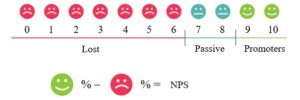
Figure 1: Net Promoter Score
Source: Authors based on TeamSupport (2023)
The NPS classifies customers into three groups as shown in figure 1. Nenadál (2016) discusses customer types from the company perspective, whereas Kozel, Mynářová and Svobodová (2011) address customer types from a customer perspective, suggesting that the following three groups of customers exist:
• Promoters/Enthusiasts – (9-10 score) – active customers/loyal supporters who recommend a product, brand or company to others – generate growth.
• Passively satisfied/Passive – (7-8 score) – satisfied customers who recommend products without enthusiasm – likely to use competitor offers.
• Lost/Opponents – (0-6 score) – dissatisfied customers who are likely to switch to a competitor and do some damage to the brand.
In using the NPS for our research, we adopted the approach of Klimin, Tikhonov and Trykov (2017), who discussed the application of the NPS method in the B2B market. Hence, our research focuses on customer satisfaction and loyalty in the B2B market.
Customer satisfaction is usually measured with the help of an index that covers a variety of factors. This research draws on the European Customer Satisfaction Index (ECSI) consisting of seven variables or factors affecting satisfaction (image, expectations, perceived product quality, perceived value, complaints), cumulative customer satisfaction, and the consequence of satisfaction – customer loyalty (Kozel, Mynářová and Svobodová 2011). Following their research results, Askariazad and Babakhani (2015) confirm that the ECSI has sufficient power in explaining loyalty in the B2B context.
Moreover, Sales-Vivo, Gil-Saura, and Gallarza (2021) argue that the quality of the customer-seller relationship in the B2B market is also influenced by the possibility of product co-creation. An article titled „The influence of service quality on customer satisfaction and loyalty in B2B technology service industry“, published by Huyan, Lee, and Chen (2019), inspired the authors of the submitted study. Huyan, Lee, and Chen (2019) aimed to determine the ways in which service quality and brand awareness affect customer satisfaction and loyalty in the B2B technology services industry. The authors state that the majority of studies in this field relate to B2C situations, such as the hospitality industry (Hyan, Lee and Chen 2019). Our research thus addresses the gap in B2B market satisfaction research with a particular focus on the technology industry.
2 Methodology
The topic of our research is to determine the satisfaction of JOBka Services, s. r. o. customers. JOBka Services, s. r. o. is the provider of a mobile application known as JOBka. It helps the application users to have relevant information concerning their company always at their fingertips, whether they are at home, at work, or on the move. The mobile application incorporates important company documents and contacts, and makes it possible to arrange a carpool or order a meal. The company operates in the B2B market. The primary objective of the satisfaction survey is to collect information from the company’s customers regarding the quality of customer service and its impact on company performance. The purpose of the research is to find out how customers perceive the services provided by JOBka Services, s. r. o.
The research is conducted using a questionnaire survey over a web interface (CAWI). The questionnaire was prepared in Microsoft Forms. As a questionnaire is the fastest way to collect both quantitative and qualitative data, it was utilized in this research. Our questionnaire combines unstructured, semi-structured, and structured parts (Eger and Egerová 2022).
Spearman’s rank correlation coefficient is a statistical measure used to express the strength and direction of a monotonic relationship between two variables. This coefficient is applicable to variables that are not normally distributed and may not be related in a linear way, but rather may be driven by other types of dependencies (Hindls 2007).
Spearman’s rank correlation coefficient ranges between -1 and 1, where:
• 1 indicates a perfect increasing monotonic correlation between the variables.
• -1 indicates a perfect decreasing monotonic correlation between the variables.
• 0 indicates no monotonic correlation between the variables.
The calculation of the Spearman correlation coefficient involves converting the values of the variables into ranks (ordinal numbers) and then calculating the Pearson correlation coefficient for these ranks.
In addition, the NPS is established to assess customer loyalty. The NPS value is calculated as the difference between the percentage of promoters/supporters and the percentage of the lost/opponents. The value can range from -100 to +100. An NPS greater than 0 is considered good. If the NPS is greater than 50, it is perceived as excellent (Kozel, Mynářová and Svobodová 2011).
The target group of this research consists of the existing JOBka Services, s. r. o. customers, including manufacturing, logistic and trading companies with some previous customer experience with JOBka Services, s. r. o. The set was randomly selected by the customer service department and comprises 60 client companies, including their employees (in-house application administrators and users).
Three hypotheses are established for the research:
H 1: There is a relationship between the application ratings and user loyalty.
H 2: There is a relationship between the impact on company performance and the loyalty of the company representative.
H 3: There is a relationship between meeting customer expectations and customer loyalty.
As previously mentioned, the questions in the questionnaire were inspired by the ECSI. The questionnaire includes both closed-ended and open-ended questions. Closed-ended questions comprise multiple-choice questions, as well as Likert-scale type questions with numerical ratings, either stand-alone or in the form of matrix questions. Open-ended questions complement closed-ended questions by providing a verbal assessment. There are two versions of the questionnaire – one for companies (application administrators) and one for company employees. In total, the questionnaire for companies includes 14 questions, whereas the questionnaire for employees (users) contains 12 questions. As employees only come into contact with the application, the questions intended for company representatives (focusing on the perceived value, expectations and the impact of the application on the performance of the company) are irrelevant for them.
The questionnaires were developed Microsoft Forms and were emailed to customers (companies) after the completion of the piloting and pre-survey phase. The end users were able to access the questionnaire directly in the JOBka application by using a specifically designated URL link.
Data collection was carried out in March 2023. The potential respondents consisted of 60 companies and their employees. The questionnaire took approximately 4 minutes for both groups to complete. The data obtained was narrowed down to exclude the results of questionnaires submitted by respondents who declined to have their opinions and assessments processed. The question regarding the likelihood of providing a recommendation was used to determine the level of customer loyalty (NPS).
The three hypotheses established at the beginning of the survey were tested with the help of the software STATISTICA, an analytical data processing tool. The non-parametric Spearman’s rank correlation coefficient was used to confirm or reject the hypotheses as the variables being studied were rated on a Likert scale, i.e., on an ordinal level of measurement.
3 Research results
In total, 29 application administrators (companies) participated in the survey, resulting in a usable sample of 28 respondents. 202 end users in companies filled in the questionnaire, yielding a usable sample of 183 respondents.
3.1 Results related to questions for the company’s application administrators
The questions intended for the companies/application administrators concerned their expectations, perceived value, and the quality of JOBka Services, s. r. o. products and services. These were questions rated on a five-point Likert scale or questions graded on a 1-5 scale, „as in school“. Respondents unable to respond to a question could select the „N“ option as an answer.
Customer expectations
The respondents used a 5-point scale to indicate whether the JOBka application met their expectations (completely met – completely failed to meet). The JOBka application completely met the expectations of half of the respondents, i.e., 14 of them. The remaining half rated the application between „met“ and „failed-to-meet“, with the substantial majority (39% = 11 respondents) indicating that the application met their expectations. Two respondents reported that their expectations were not met.
Impact on performance
Respondents used a 5-point Likert scale to indicate the JOBka application’s impact on component performance factors (significantly positive impact – significantly negative impact). The efficiency/performance factors included cost, time, employee satisfaction, and employee turnover/employment rate. The application has no effect on increased employee turnover or the employment rate, as indicated by 19 respondents. The second aspect not affected by the JOBka application, according to 14 respondents, is the cost. It has a positive impact on employee satisfaction and time efficiency. In terms of employee satisfaction, 93% (26) of respondents acknowledge its positive impact, with the majority of respondents (18 administrators) considering the application to be positively influential. The positive impact with respect to time efficiency is indicated by 86% (24) of respondents, with 14 of these perceiving the product as having a significant positive impact. Two administrators report that it has a negative impact on costs, and one on time efficiency and employee turnover.
3.2 Results related to questions for in-company end users
The questions for employees relate to the quality of the company’s products and services. These are matrix-type questions, with respondents rating factors or components of the topic being addressed in each question. The end-users rated these questions on a 1 to 5 scale. Respondents unwilling or unable to respond to a question could select the „N“ option as an answer.
Mobile application
The respondents individually assessed the main parameters of the application, namely appearance, arrangement, speed, content, and functionality of the application modules. Respondents unwilling to respond to a question could select the „Don’t want to rate“ option as an answer. 174 users rated the module arrangement and functionality, 177 users rated the content, and 179 users rated the speed.
For a graphical representation of the assessment of individual aspects of the application, see Figure 2.
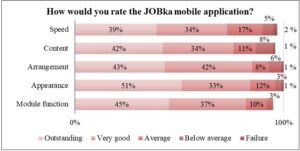
Figure 2: Graphical representation of the JOBka mobile app assessment
Source: Authors
As the figure shows, all aspects were rated predominantly positively, with scores of „outstanding“ and „very good“. The aspects rated as failure included speed (4 respondents) and content, arrangement as well as appearance (2 respondents each).
3.3 Results of identical or related questions for both groups of respondents
Identical questions for company application administrators and end users concerned the frequency of use of the application and the likelihood of recommending JOBka Services, s. r. o.
Frequency of use of the JOBka application
Both groups of respondents indicated the frequency of use of the JOBka application. For a graphical representation of the results related to the frequency of use see Figure 3.
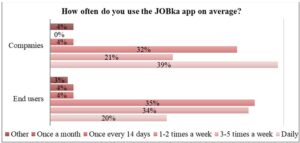
Figure 3: Graphical representation of the results related to the frequency of use
Source: Authors
As the graph shows, companies used the app the most (on a daily basis). These are major companies with more than 500 employees. Conversely, the end-users mostly selected the 1-2 times a week option. A total of 162 employees (89%) visit the app at least once a week. 6 employees use the application once every six months or rarely.
Customer loyalty
Customer loyalty was measured using the NPS. Both company representatives and end-users rated the likelihood of recommending the company to their community. They had an 11-point scale at their disposal, where 0 = not at all likely and 10 = very likely.
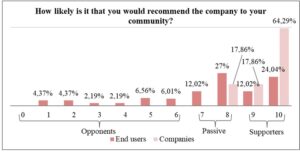
Figure 4: Graphical representation of the results related to the likelihood of recommendation
Source: Authors
As Figure 4 shows, end-users are represented in all groups, whereas company representatives are only part of the passive and supporters groups. The number of opponents among the end users is 47 (25.69%). Passive customers comprise the largest group, amounting to 38.25% (70 respondents). The supporters account for 36.07% (66 employees).
The results for company representatives indicate a substantial likelihood of recommendation. 82.14% of them (23 respondents) qualify as supporters. The remaining 17.86% of respondents, i.e., five companies, are passive customers.
3.4 NPS calculation
As noted above, the NPS value can be calculated as the difference between the proportion of supporters and the proportion of opponents, as shown in Table 1.
| Net Promoter Score | Company end-users | Companies (application administrators) | ||
|---|---|---|---|---|
| Supporters | 66 | 36.07% | 23 | 82.14% |
| Opponents | 47 | 25.68% | 0 | 0% |
| NPS | 10.39 | 82.14 |
Table 1: NPS calculation
Source: Authors
The NPS for JOBka Services, s. r. o. is 10.39 and 82.14. The overall value of 10.39, which is essentially a good score, is based on the likelihood of recommendation by the end-user. The outstanding score of 82.14 describes the likelihood of recommendation by companies. It is made up of supporters only.
3.5 Assessment of research hypotheses
The research includes three proposed hypotheses about the relationship between variables based on the European model of customer satisfaction and variables concerning the effectiveness of the customer’s business. The variables are: the assessment of the mobile application, the product impact on customer business efficiency, employee attitude, and the loyalty assessment. The hypotheses will be confirmed or rejected on the basis of the data provided by the respondents in the questionnaire survey.
The associations between the variables are investigated using Spearman’s correlation coefficient, which helps determine the relationship between ordinal variables.
H1: There is a relationship between the application ratings and user loyalty.
The hypothesis was tested using data obtained from the application end-users. In particular, the answers to the question about the mobile application assessment, and the question concerning the level of customer loyalty, were used.
| Variables (N = 183) | Appearance x Loyalty | Arrangement x Loyalty | Content x Loyalty | Speed x Loyalty | Module functionality x Loyalty |
|---|---|---|---|---|---|
| Spearman’s ρ | 0.474879 | 0.340932 | 0.316380 | 0.346963 | 0.148442 |
| t(N-2) | 7.259627 | 4.879095 | 4.486953 | 4.977096 | 2.019462 |
| p-value | 0.000000 | 0.000000 | 0.000000 | 0.000000 | 0.000000 |
Table 2: Relationship between the application ratings and user loyalty
Source: Authors
Table 2 shows the relationship between the variables. Spearman’s ρ determining the relationship between loyalty and individual variables (appearance, arrangement, content, and speed) indicates a moderate increasing monotonic correlation between them. The correlation between loyalty and module functionality, where ρ came out just under 0.15, is low. Based on the p-values of less than 0.05 for all correlations, H1 can be fully confirmed.
Contingency table 3 shows that supporters most frequently rated all components of the mobile application as „outstanding“. The sum of the individual factors varies as some respondents did not rate the respective components.
| How would you rate the mobile application? | Opponents (0-6) | Passive (7-8) | Supporters (9-10) | Total |
|---|---|---|---|---|
| Outstanding | 13 | 34 | 46 | 93 |
| Very good | 13 | 29 | 19 | 61 |
| Average | 18 | 4 | 0 | 22 |
| Below average | 3 | 2 | 0 | 5 |
| Failure | 0 | 2 | 0 | 2 |
| Appearance total | 47 | 71 | 65 | 183 |
| Outstanding | 10 | 24 | 44 | 78 |
| Very good | 15 | 41 | 21 | 77 |
| Average | 13 | 2 | 0 | 15 |
| Below average | 9 | 2 | 0 | 11 |
| Failure | 0 | 2 | 0 | 2 |
| Arrangement total | 47 | 71 | 65 | 183 |
| Outstanding | 8 | 19 | 44 | 71 |
| Very good | 8 | 34 | 21 | 63 |
| Average | 18 | 14 | 0 | 32 |
| Below average | 9 | 0 | 0 | 9 |
| Failure | 2 | 2 | 0 | 4 |
| Speed total | 45 | 69 | 65 | 179 |
| Outstanding | 8 | 20 | 49 | 77 |
| Very good | 10 | 39 | 14 | 63 |
| Average | 13 | 6 | 2 | 21 |
| Below average | 12 | 2 | 0 | 14 |
| Failure | 2 | 0 | 0 | 2 |
| Content total | 45 | 67 | 65 | 177 |
| Outstanding | 8 | 29 | 46 | 83 |
| Very good | 16 | 32 | 19 | 67 |
| Average | 12 | 6 | 0 | 18 |
| Below average | 4 | 2 | 0 | 6 |
| Failure | 0 | 0 | 0 | 0 |
| Module functionality total | 40 | 69 | 65 | 174 |
Table 3: Frequency of relationship between the application ratings and user loyalty
Source: Authors
H2: There is a relationship between the impact on company performance and the loyalty of the company representative.
The hypothesis was evaluated using data obtained from the application administrators. In this case, the answers to the question concerning the impact on company performance, and the answers to the question about loyalty, were used.
Based on the calculations of the Spearman coefficient in table 4, the associations between loyalty and cost and loyalty and employee satisfaction are virtually non-existent as the values are close to 0. The Spearman’s ρ values for the variables of loyalty, time, and employee turnover indicate a very small association between them. All four correlations are insignificant, as p > 0.05. Therefore, H2 is rejected. There is no relationship between the impact on company performance and the loyalty of the company representative.
| Variables (N = 28) | Cost x Loyalty | Time x Loyalty | Satisfaction x Loyalty | Turnover x Loyalty |
|---|---|---|---|---|
| Spearman's ρ | 0.005543 | 0.134286 | - 0.040042 | 0.126597 |
| t(N-2) | 0.028264 | 0.690987 | - 0.204338 | 0.650756 |
| p-value | 0.977668 | 0.495697 | 0.839681 | 0.520914 |
Table 4: Relationship between the impact on company performance and the loyalty of the company representative
Source: Authors
H3: There is a relationship between meeting customer expectations and customer loyalty.
The hypothesis was tested using questions from the application administrator questionnaires. The data is based on the answers to the question „Has the JOBka application met your expectations?“ and the question concerning loyalty. As can be seen in table 5, the association between loyalty and meeting expectations is insignificant, with p > 0.05. Thus, H3 is rejected, There is no relationship between meeting expectations and customer loyalty.
| Variables (N = 28) | Meeting expectations x Loyalty |
|---|---|
| Spearman's ρ | - 0.11206 |
| t(N-2) | - 0.57501 |
| p-value | 0.57023 |
Table 5: The relationship between meeting expectations and customer loyalty
Source: Authors
4 Discussion and implications
In most cases, the questions were assessed positively. The JOBka application fully met the companies’ expectations 50% of the time. Only two respondents indicated that their expectations were not met. The mobile application has a mostly positive to significantly positive impact on employee satisfaction and time efficiency. It does not have an impact on employee turnover and company costs in particular.
Company employees gave more negative ratings than company application administrators. This may be due to the fact that the end users are not in direct contact with JOBka Services, s. r. o. and can only voice their complaints through reviews in the App Store, Play Store or within the My JOBka World module. Or they communicate their complaints to their employer’s application administrator and wait for the complaints to be forwarded to the consultants. The company’s application administrators can directly contact the customer service department by phone or email, and receive more attention from the customer service department.
Customer loyalty also contributes to a positive assessment of the company. Company representatives have shown to be very loyal customers, with the NPS value amounting to 82.14 (23 supporters, 5 passive, and 0 opponents). Given the limited surveyed sample (60 firms), with almost half of them responding, the NPS value is based on only 18% of all the company’s client firms. The NPS related to end users is significantly lower at 10.39. The number of loyal customers is 66. The smallest group is the group of opponents (47). However, this represents more than a quarter of the employees, and unless passive customers (comprising the largest group of 70 employees) are included in the NPS calculation, the NPS value is low.
The next step was to test the hypotheses. Only hypothesis 1 demonstrated the existence of a relationship, which concerned the association between customer evaluation of the mobile application and customer loyalty. In this case, only individual features of the application were evaluated. Appearance, overview, content and speed represent a moderate association relative to loyalty. The correlation between module functionality and loyalty is low to moderate. Hypothesis 2 is rejected. There is no relationship between customer loyalty and the impact on the company’s performance. Hypothesis 3 is rejected, too. The relationship between loyalty and meeting customer expectations cannot be confirmed.
Most of the respondents were satisfied or rated the product and services favourably. However, the results show that the company received worse ratings from end-users in companies. As mentioned above, employees are unable to contact the customer service centre directly, which may be the main reason for the lower level of satisfaction. The company should focus more on the users, for example, by conducting regular satisfaction surveys that would include mostly open-ended questions concerning the application’s issues and allow the users to share suggestions for improvements and innovations, enabling them to participate in product development. Alternatively, an in-application module could provide mobile and electronic contact to a consultant assigned to the company, or this issue could be handled by a call centre that would be available to end users. Based on extensive research involving a total of 1,692 respondents, Gansser, Bossow-Thies and Krol (2021) demonstrate that trust in a supplier is key to developing and maintaining a long-term relationship. JOBka should continue building trust, both with application administrators and individual users through direct means of communication.
Kebab (2025) states that two key factors – „perceived usefulness and perceived ease of use“ – directly influence an individual’s intention to use a given new technology. So, it is precisely these two characteristics that JOBka should focus on when marketing the application to end users.
Guo and Wang (2015) provide research-based managerial implications for B2B enterprises regarding strategies for market focus implementation related to successful customer relationship management. They identify competitor focus as a factor that exerts a stronger impact on customer satisfaction than customer focus. Consequently, we recommend that JOBka keeps assessing its competitors and clearly differentiates itself to its customers, which has a demonstrably positive impact on customer satisfaction.
In the future, this research can be expanded to include other B2B sectors in order to validate the present findings in different industries. It is also advisable to assess the impact of moderating variables. This research can provide guidance to other technology and/or service providers in the B2B market on how to assess customer satisfaction and loyalty.
5 Conclusion
Satisfaction and loyalty in the B2B market are key to the success of any business. This refers to the way companies maintain and strengthen their relationships with their customers, such as other businesses, organisations or institutions. Attracting and retaining satisfied and loyal customers can have a significant impact on the long-term growth and stability of a business. Customer satisfaction in the B2B market is primarily affected by trust in the business partner, communication, professionalism, product quality, and the terms of delivery. In addition, loyalty as the ultimate level of customer relationship is determined by an excellent customer experience, and additional value within the extended product, all of which can significantly distinguish the company from its market competitors. In order to achieve a high level of satisfaction and loyalty in the B2B market, it is important to regularly assess customer needs, monitor competition, and continuously improve products and complementary services. It is equally beneficial to create personalised experiences and be flexible in accommodating individual client requirements. Investing in developing customer relationships and strengthening existing ones is key to sustaining long-term success in the B2B market.
The study examines customer satisfaction and loyalty in the B2B market, focusing on a technology company, JOBka Services,, s. r. o., which offers a mobile communication application. The research employs the NPS and the ECSI to assess customer relationships. Using questionnaires sent to 60 client companies and their employees, the study analyzed satisfaction, perceived value, service quality, and loyalty. Findings show that company representatives generally report high satisfaction and loyalty (NPS = 82.14), while end-users are more critical (NPS = 10.39). Factors such as trust, communication, product quality, and service personalization significantly influence satisfaction in the B2B context. Among the three hypotheses tested, only the one linking app rating with user loyalty was confirmed. The study concludes that B2B customer loyalty hinges on continuous product improvement, responsive service, and personalized client engagement. The study recommends expanding similar research across other industries for broader insights.
Poznámky/Notes
This work was supported by the University of West Bohemia under Grant SGS-2024-031.
Literatúra/List of References
- Askariazad, M. H. and Babakhani, N., 2015. An application of European Customer Satisfaction Index (ECSI) in business to business (B2B) context. In: Journal of Business & Industrial Marketing. 2015, 30(1), 17-31. ISSN 0885-8624.
- Eger, L. and Egerová, D., 2022. Metodologie výzkumu. Plzeň: Západočeská univerzita v Plzni, 2022. ISBN 978-80-261-1108-5.
- Gansser, O. A., Bossow-Thies, S. and Krol, B., 2021. Creating trust and commitment in B2B services. In: Industrial Marketing Management. 2021, 97, 274-285. ISSN 1873-2062.
- Guo, C. Q. and Wang, Y., 2015. How manufacturer market orientation influences B2B customer satisfaction and retention: empirical investigation of the three market orientation components. In: Journal of Business & Industrial Marketing. 2015, 30(2), 182-193. ISSN 0885-8624.
- Hendl, J., 2015. Přehled statistických metod zpracování dat: Analýza a metaanalýza dat. Praha: Portál, 2015. ISBN 978-80-262-0200-4.
- Hindls, R., 2007. Statistika pro economy. Praha: Professional Publishing, 2007. ISBN 978-80-86946-43-6.
- Huyan, P. L., Lee, B. C. Y. and Chen, C. C., 2019. The influence of service quality on customer satisfaction and loyalty in B2B technology service industry. In: Total Quality Management & Business Excellence. 2019, 30(13-14), 1449-1465. ISSN 1478-3363.
- Kebab, M. 2025. Travel app adoption intentions: Extending the technology acceptance mo-del with trust. In: Marketing Science & Inspirations. 2025, 20(2), 45-58. ISSN 1338-7944.
- Klimin, A. I., Tikhonov, D. V. and Trykov, A. V., 2017. Methodological problems of NPS index application for measuring customer relationship in B2B. In: Vision 2020: Sustainable Economic Development, Innovation Management, and global Growth. IBIMA, Madrid, Spain, 2017, I-IX, 3149-3160. ISBN 978-0-9860419-9-0.
- Kozel, R., Mynářová, L. and Svobodová, H., 2011. Moderní metody a techniky marketingového výzkumu. Praha: Grada, 2011. ISBN 978-80-247-3527-6.
- Kumar, V. and Reinartz, W., 2012. Customer relationship management. Concept, strategy, and tools. Berlin: Springer – Verlag, 2012. ISBN 978-3-662-55380-0.
- Malhotra N. K. and Agarwal J., 2020. Customer relationship marketing: Theoretical and managerial perspectives. Singapore: World Scientific, 2020. ISBN 978-1-944659-71-4.
- Nenadál, J., Noskievičová, D., Petříková, R., Plura, J. and Tošenský, J., 2008.
Moderní management jakosti: principy, postupy, metody. Praha: Management Press, 2008. ISBN 978-80-7261-186-7. - Sales-Vivo, V., Gil-Saura, I. and Gallarza, M. G., 2021. Comparing relationship of quality-satisfaction models: effects of B2B value co-creation. In: International Journal of Retail & Distribution Management. 2021, 49(7), 941-957. ISSN 0959-0552.
- Šrédl, K., Soukup, A. and Severovál, L., 2013. Models of consumer’s choice. In: E & M Ekonomie a Management. 2013, 16(2), 4-9. ISSN 1212-3609.
- Suoniemi, S., Zablah, A., Terho, H., Olkkonen, R., Straub, D., and Makkonen, H., 2022. CRM system implementation and firm performance: the role of consultant facilitation and user involvement. In: Journal of Business & Industrial Marketing. 2022, 37(13), 19-32. ISSN 0885-8624.
- TeamSupport, 2023. How to measure Net Promoter Score (NPS) for customer success. 2023. [online]. [cit. 2023-05-07]. Available at: <https://www.teamsupport.com/blog/customer-success-net-promoter-score-nps>
- Wenzler, M., Bhambhani, S. and Schmidthaler, M., 2019. Readiness, use and enablers of digital customer interaction tools in Austria. In: Marketing Science & Inspirations. 2019, 14(2), 2-9. ISSN 1338-7944.
Kľúčové slová/Key words
B2B market, client requirements, customer loyalty, customer relationship management, customer satisfaction, European Customer Satisfaction Index, technological services
B2B trh, požadavky klientů, loajalita zákazníků, řízení vztahů se zákazníky, spokojenost zákazníků, Evropský index spokojenosti zákazníků, technologické služby
JEL klasifikácia/JEL Classification
M31, L86, D22
Résumé
Hodnocení spokojenosti a loajality na trhu B2B se zaměřením na poskytování technologických řešení
Tento článek si klade za cíl představit výsledky výzkumu spokojenosti a loajality zákazníků na trhu B2B se zaměřením na poskytování technologických služeb ve vztahu k vybrané inovativní společnosti. Loajalita zákazníků je vrcholem všech aktivit v oblasti řízení vztahů se zákazníky (CRM). Jak loajalitu, tak spokojenost je třeba sledovat a měřit, aby bylo možné je vyhodnotit. Jedním z nástrojů pro měření loajality je metrika známá jako Net Promoter Score, kterou jsme použili v našem výzkumu. Spokojenost zákazníků se obvykle měří pomocí indexu spokojenosti zákazníků. Tento výzkum vychází z Evropského indexu spokojenosti zákazníků (ECSI), který je určen sedmi hypotetickými proměnnými či faktory ovlivňujícími spokojenost (image, očekávání, vnímaná kvalita produktu, vnímaná hodnota, reklamace), kumulativní spokojeností zákazníků a důsledkem spokojenosti – loajalitou zákazníků. Jak ukazují výsledky výzkumu, pro dosažení vysoké úrovně spokojenosti a loajality na trhu B2B je důležité pravidelně posuzovat potřeby zákazníků, sledovat konkurenci a neustále zlepšovat produkty a doplňkové služby. Spokojenost zákazníků na trhu B2B je především ovlivněna důvěrou v obchodního partnera, komunikací, profesionalitou, kvalitou produktu a dodacími podmínkami. Kromě toho je loajalita jako konečná úroveň vztahu se zákazníkem určena vynikajícím zákaznickým zážitkem, věrností a doplňkovými hodnotami v rámci rozšířeného produktu, což může společnost výrazně odlišit od jejích konkurentů na trhu. Tento výzkum se zaměřuje na mezeru ve výzkumu spokojenosti na trhu B2B, a to zejména v oblasti technologického průmyslu.
Recenzované/Reviewed
1. November 2025 / 7. November 2025